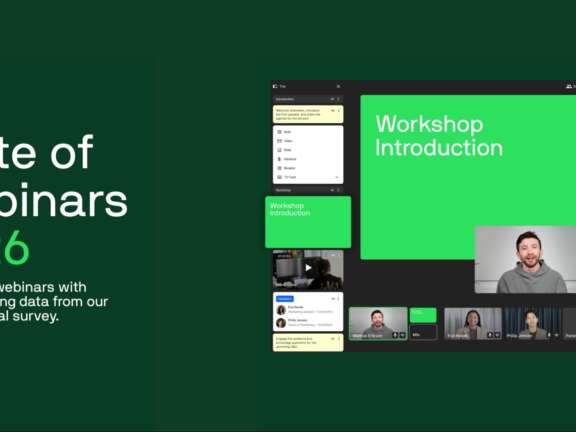
Webinar: The State of Webinars 2018
A decade-old marketing strategy, webinars are important channel for any marketing team looking to engage their audience, increase leads, and educated their customers. But what is the state of webinar tools in 2018?
We analyzed results from marketers around the world to find out how marketers feel about the current webinar tools, how webinars are run, and the results that matter most.
Category
WebinarsView transcript
Today we'll be diving into the research on the state of webinars, which Todd Patton has been conducting. Todd is with us here today. Todd? houetteHey, Madeleine. Thanks for joining me on this webinar. Today we're going to talk a little bit about the state of webinars, not only the tools, but what kind of analytics and metrics that marketers look at most when it comes to webinars. So I'm excited to dive in and see if you talk about a few different aspects of webinars today. houetteSo tell me a little bit about Todd. Like, why was it that you ended up actually diving into this topic particularly? houetteYeah, so I mean, reason number one, we just launched our webinar tool and we wanted to understand the space a little bit better, right? Reason number two, we kind of got this overwhelming sense as we did market research that people don't really like their webinar tools. And webinars have been around for literally decades. Like, people have been running web seminars for the last 20 years. It's probably one of the oldest MarTech categories we have. But sometimes when you look at the webinars that are being run, they look a little old school, the UI and UX is a little off. And so we wanted to understand a little bit better how marketers feel about not only their tools, but webinars in general. houetteCool. So tell me a bit about like, I mean, I'll let you dive a bit more into the details as well in the findings. And I know that you also have some supporting slides that you're able to also run through. But first and foremost, what was the most shocking relation of this research? Yeah, so there were a few. I mean, there were there were a few stats that we had hypothesis about. And they actually came kind of to fruition, we saw that, oh, this is exactly what we imagined, I can actually dive into it a little bit. So I have some slides here. Probably the most shocking, I would say. I mean, I knew marketers ran a lot of webinars. So this, this stat is kind of on par with what I thought. But the one that actually really took me by surprise was this stat right here, that 68% of marketers either measure webinars manually or currently not measuring the success of webinars, which is actually absolutely crazy to me. You know, if you think of any other martech tool, we measure everything with it. If it's marketing, automation, or email marketing, landing pages, whatever blogs, whatever it might be, we have the deepest analytics with them. And so it's just curious to me why webinars are lacking behind so much, and why marketers aren't really measuring the success because they can be huge generators of revenue, revenue, first of all, but also engagement, right. And it's a really good way to see if someone's engaged, if someone attends a 45 minute webinar, you know, they're pretty interested in the thought leadership that you have, but also maybe the message that you're trying to convey. So this step was the one that actually stood out to me quite a bit. But it's something we're trying to actively change at 23. So I mean, based on that, I mean, it's this is shocking, but as well, like, did you dive in anything into why marketers are doing webinars these days? Yeah, so we did, we did some research involving, like, the underlying point of why they're actually running them, right? What metrics are they measuring? And we asked a few questions, actually. So those questions were, we asked a question about which metrics are most important. The first one being attendees, signups, so just generic leads, revenue, actually, engagement, so people actually attend and stay and watch the whole thing. And most of them fell under like 50%. Right? So that not more than half of marketers measured any one statistic, when really, it should be all marketers should be measuring all of these statistics, right? It's like, if you think about your blog, you wouldn't ignore the time on page spend, or the CTA at the bottom, right? That if someone clicked on a CTA, and they signed up for on a landing page, or whatever it might be, you wouldn't ignore that. But it kind of seems like marketers are all over the place on webinars. And it's something we need to change all of us. Interesting. So could you just take us through kind of the key takeaways that you you got from from the report? Yeah, so I made of these few slides, we kind of already saw the first one, but I'll start at the beginning. And that, so I'll just I'll just go through these, I think there's five stats in here. So the first one is that 45% of marketers run 11 plus webinars a year. And then throw on top of that 19% run 50 or more webinars a year, which is a pretty big number, right? I mean, that's nearly one a week, maybe more for some, right? And it's so it's, I think that this is evidence that nearly 70% of marketers are running a lot of webinars a year. But like I said, in the stat that we showed earlier, is they're not really measuring it, right? And they're either doing it manually through spreadsheets, or currently not really measuring what the success of their webinars are. The other thing, the other side of webinars too, is that of course, they can be run live, right? Like we're running a webinar live right now. But a lot of the value from a webinar can come afterwards, too. These pieces of content are pretty evergreen. I mean, they're something that you can put on your website, you can put it on YouTube. We wouldn't exactly recommend that. I mean, there is some SEO value there. But especially on your website, we wanted to know where marketers were hosting their on demand. And nearly 60% 59% of marketers hosted on either YouTube, Vimeo, Dropbox, or Google Drive, which as you can see written here, that eliminates a lot of the valuable engagement and conversion data that you can get from these webinars. So you can see that like someone actually filled out a gate that was on a video or a form, we call them collectors at 23. And you can see exactly how much of the webinar they watched. And if you look at the engagement data, and people are dropping off after one or two minutes, and it's a 40 minute webinar, maybe you should it's time to circle back with that content, and realize that something needed to change, or you should have changed what you were talking about, because that message might not be resonating. But on the other hand, if you are seeing that people are watching 90%, on average of an entire webinar, that content was super strong. But you don't get this data if you're hosting it on YouTube and third parties like Vimeo and Dropbox, and things like that, you're missing out on a big segment of data that you could be using to nurture people, your sales team could be using to move people down the funnel towards a conversion. I've even seen B2C companies running webinars recently, one of them is, it's called StockX, it's a company in Detroit that values the price of shoes. And they have a weekly series where they break down all the latest trends and shoes and everything like that. So I think there's so many different ways that businesses can start using webinars. The other one is we wanted to know what the net promoter score of webinar tools are globally, like I mentioned earlier, they're a little clunky, a lot of them require downloads to even watch it, which can be blocked by firewalls and things like that. The metrics aren't that great, they don't show you what marketers need to know, some of them are born of web conferencing tools. And so our hypothesis was that people, you know, generally don't like their webinar tool. And we kind of found that out to be a fact. So we ran a net promoter score in the same survey, and saw that it was minus 28. Right? A good score would be around plus 40. And so as you can see, it falls behind the rest of the tech stack and how it compares to other tools that people are currently using for their other campaigns. And then this one, this note, this stat is actually pretty astounding to me as well. I mean, what other tool can you think of where you use multiple tools to run a single webinar, right? We found that 68% of marketers use two to five tools to run a single webinar, and then 9% use five or more tools. So that was kind of the crux of the 23 webinar platform or webinar tool is that we wanted to make it something that was all in one that marketers only had to go to this one place to run their webinars, to analyze their webinars. Of course, we have integrations with like HubSpot and Marketo and Salesforce, where you can see all that valuable data. But we wanted a tool where it wasn't clunky, and you could run everything in the same place. And that's why we wanted to find out, on average, how many tools are marketers using? So a huge patchwork and a lot of hacky solutions to pull off a webinar, it seems like. Exactly. Cool. I mean, through kind of the I mean, I know that a lot of this has also been a bit more quantitative research, but were you able to in some way get an understanding of what the dream scenario would be for, for someone using webinars, what the tool should should look like, what functionalities it should have in order for for not using five different tools to pull off a webinar? Yeah, so we did. We did dive into, like, which what was the most coveted? What were the most coveted? Like, I guess you could say features of a webinar tool. And so yeah, we dove into that. Let me just pull up the numbers real fast and break them down. Because it is super important, I think. And so some of the things that we asked were updated design, right? Does it have a modern looking feel to it? Custom landing pages, custom transactional emails, because a lot of the webinar tools today have kind of old looking 90s style emails, and we wanted to see if people actually wanted to be able to send custom branded emails. We asked about promotional tools, integrations with the tech stack, whether they wanted it to be in browser, so you didn't have to download anything. And then of course, there's like the post follow up tools, the emails, the recording of the video, automatic publication, a webinar hub for all the demand on demand webinars, like we talked about earlier. And then of course, the last one would be the number of attendees, we asked if they would want to have unlimited number of attendees, and about a fourth of people said, yeah, that is something that I would be interested in. Wow, interesting. And so, I mean, after having run all this amazing research, and now you with the findings that you have there, what would be your kind of tips, tricks, hacks? What would you say marketers should do? Yeah, I think this is kind of a twofold question, right? There's some marketers that are very experienced with webinars, and they've ran them quite a bit, right? And there's some webinars that have never used webinars to engage their audience. And I think an important thing is if you have never done it is to just test it out. I always say that's always I feel like that's the standard answer is that you should always just test it out and see if it resonates. And then for people that have already been running webinars, I think really getting down to measure I talked about it earlier, but measuring that engagement to see if people are actually watching. Because if the people aren't actually watching, it's a waste of everyone's time, especially the marketer or the organizations that's investing so much in webinars. So I think it's super important to note that to measure those engagements, measure those conversions and start measuring everything when it comes to webinars, just how you would with any other strategy. As far as like tips and tricks. I mean, so even on this webinar, we've been testing out a strategy to see if a 15 minute webinar worked better than a 45 minute webinar. And we're going to run a study on this, right? So testing out the different types of content, trying to do like a webcam like we're doing now, running slides, testing out which one works better with your audience. There's so many different ways. And at the end of the day, webinar content is video content, and it should be treated as such. And it should be integrated in your tech stack. And you should be able to see and lead score and set up attribution based on webinars. So I think it's really about testing things out and trying the different types of content that are available. Because we've gotten so accustomed to excuse me, we've gotten so accustomed to webinars just being slides and someone talking over it. But there's so many different mediums that you can go with. You could do a sit down interview, right? Kind of like what we're doing here, or be in the same room, or talking to someone across the world on a Q&A. And then try it out, you know, using slides as well and doing presentations and everything like that. So I think there's a lot of different options where people can go. Amazing. Thank you so much, Todd. This is really interesting research that they've done. You'll also be writing up a blog post on this, but I hope that we can also put a link to it here. And upcoming, like what things will you be diving into in the next webinar, you think? So the first one that we did in this kind of 15 minute series surrounded the seven things for a complete video marketing strategy. And so we'll probably go back and forth between webinar advice and video advice. Our platform kind of uses all of those things. So we want to really have the education behind them too. So it'll probably go back and forth. The next one I think will be about video. We've ran some studies about the state of online and the state of video marketing, which we've talked a lot about in the past. So it'll be more of that. And then the other thing is that we do have our marketing expert series, which we are doing another batch of episodes this fall. And so it's kind of like, it's a little bit of a webinar in a way, I guess you could say, but it's a sit down interview with like CMOs and CEOs, which Maddie, you've been involved with a lot. Yeah, we're going to be seeing a lot of really interesting interviews coming out with everything from Scott Brinker to many other marketers who are very interested and also using a lot of video marketing. So also being able to be very actionable and hands on. Hopefully you're able to take home something that will make your video marketing project a success. So yeah, so thank you so much, Todd. And then we'll have much more content coming out on this topic as well to follow up. All right. Thanks, Maddie. Thank you. Bye.


