Webinars in Organisations
See how our Product and Design teams follow trends to build the webinar software of the future, and get a look behind the (red velvet) curtain on the hows and whys of WebinarDays from our Head of Marketing.
Learn from:
Julius Altenburger - Lead Product Manager, TwentyThree
Sander Kuypers - Head of Design, TwentyThree
Category
WebinarDays 2023View transcript
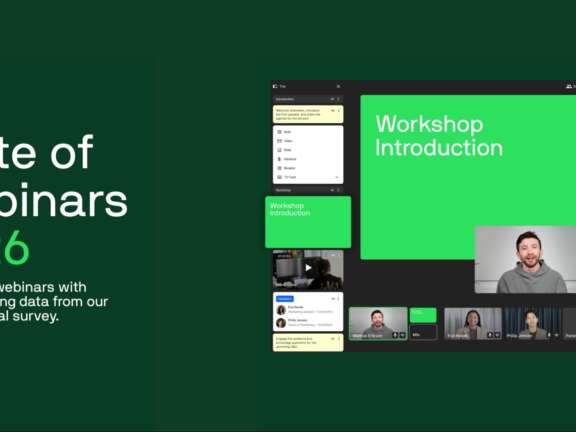
Well, hello and welcome so much to WebinarDays 2023. You guys are joining me live at the TwentyThree headquarters that is powering WebinarDays. We're currently in the Hub where you can see we're getting ready for Christmas. So we've put up our Christmas tree. And the Hub is where we gather as a company to have lunch, host physical events, and build a type of community together. So this room is very, very special for us. But now I'm going to walk you to our studio. And I figured I would start off WebinarDays this year by giving you guys a little bit of insight into behind the scenes. So if you want to say hi, we have our producer sitting over here. And then come this way. I want to show you guys our studio. This is our studio. Here we have a plug and play webinar setup that enables the company where any employee from any team can come down and book the studio, plug in their computer, and host a webinar. Today, we're going to be using this space as one of our stages. And here we have our setup with a teleprompter. You can see some lights. And a little trick I want to show you is this curtain right here, because now you can see the tiles on the wall, which gives it a very rough vibe, kind of street. And just like that, it feels like a completely different room. And then this will act as the backdrop in some of the internal sessions that we're hosting. But now, let me show you my spot. If you follow me along, you can see we have some screens set up over here. And I'll grab my iPad so that I can have my notes with me. And this is my hostess corner, if you will. I'll walk over to my tape bit so I can see my screen where I have the webinar room live. I have some of my notes on the second screen over here. And then I will be looking directly into the camera and talking to all of you. Hi. So without further ado, welcome so much to Webinar Days 2023, the annual event for everyone doing webinars. My name is Amelia Holmston. And in my everyday job, I work here at 23 as part of the marketing team. But for the next two days, I will be the host for Webinar Days, and we will go on a journey together to find out how you guys can up your webinar game and bring it to the next level. We're going to be talking to people from all over the world, professionals within webinars, great experiences, and some video producers. We're going to have a great time. So Webinar Days is hosted and brought to you by 23. Our video tools are used by marketers in both growth companies as well as some of the biggest enterprise companies in the world to do video and their webinars. We run over thousands of videos every year. And we are bringing it all to you in one platform. So if you're ready to get real with videos and use a tool that is integrated to other platforms, you as well as other teams can scale your video efforts to the thousands. With Webinar Days, we want to move the market forward. And we see it as part of our mission to host these digital events to help drive the field forward. Our aim is to inspire and we want to encourage all of you that are participating to help us do that and share your own experiences. With this year's program, we're encouraging you to think webinars everywhere in your business and really challenge what a webinar format means to you. We want you guys to understand the power of webinars from all the different perspectives that an organization can bring. So for the lineup this year, we are going to be talking to content marketing legend and Hanley and some of the best webinar creators in Europe to inspire just that. I want to thank all the speakers who during the next two days will help thousands of teams and webinar marketers around the world to improve their webinar production setups, their strategies, their distributions, and all this good stuff. We will be exploring how webinars is breaking out of the marketing department and how companies are helping connect with their audience throughout the entire funnel. For a long time, webinars has been thought of as a marketing tool that has been quite powerful. Now, in newer times, we see this tool being distributed throughout the company, which can also bring some challenges, bringing more people involved in such a project. However, we're going to get to the nitty gritties of that. Whether it's a flagship event or brand building or monthly thought leadership webinars or weekly customer briefings, webinar have become one of the most human ways to engage in a world that's becoming more and more remote. I would love to kick today off by introducing our platform, the webinar room that you guys can see me through right now. So if you have any questions, I really encourage you to ask them. We do have a questions feature that you can find above the chat. This question feature is a golden opportunity for you to get your questions shown on screen. And get it answered by the particular speaker. If you want to engage with our speakers, but you don't have a specific question you want to ask them, we do also have reactions that you can use. So we can practice right now. If you go to the left of the chat, you can see some emojis. Pick your favorite one. And let me know that you guys are well and watching and super excited to be part of webinar days. Yes, great. I see some thumbs up. I see some claps. Some clapping. Some hearts. Yes. Yes, you guys got this. That's perfect. Please, I encourage you to engage. It's so rewarding for the speakers to see how you guys are reacting to their talks and really fun for us to get some to get to know each other a little bit better. But now, I would like to know, like I told you, we are coming to you live from Copenhagen in Denmark. And I would like to know where all of you are located. So please let me know in the chat, right, either country or city that you're located from. And let's see where everyone is tuning in from. It's always such an exciting exercise when you're hosting a digital global event like this, because people could be situated literally all over the place. All over the world. Can we see some answers coming in here? Yes, London, UK, Saschborg, Norway, Munich. Amazing. I love it. Oh, yes, that's so exciting. I'm going to have to have a look at that afterwards to see where everyone is tuning in from. Great job. So as you can see, we do have people joining us from all over the world. And it's just really exciting to see all of us come together for the common purpose of improving our webinar games. I want to give a special shout out to anyone who has gotten up extra early this morning, maybe located in the northern or southern Americas. Also, thank you to everyone in Europe who's tuning in during their workdays. And I'm sure that being in the same room together, even though we can't see each other, I hope we're going to get to know each other a little bit throughout these days and at least feel like we've been in the same room together. But now let's get started. If you have a look at the top three worst fears that webinar creators have, I guess you guys can come up with some different suggestions. If you were hosting a webinar or you were a webinar creator, please enter into the chat. What would be like your top three worst fears that you can imagine happening? Well, my worst fear is having a last minute cancellation from a speaker on the day, which we cannot help. It is life. It is what happens. We are all human. Unfortunately, that is what happened to us this morning. It was the case for our friend Nick de la Force. We were supposed to kick things off with a keynote from Nick, who has been doing webinars for companies like Apple and Microsoft. But this morning, unfortunately, he had to let us know that he had fallen sick and was not able to join. So we're sending him all of our best wishes and we hope that he's going to get well soon. And hopefully he will have the chance to join us tomorrow for our cocktail hour, where you can still rack his brain and get some of his golden insights on how he sees webinar trends evolving. However, with a little crisis in house, who do you turn to? Well, your colleagues and your friends. So I have gotten a little bit help from my own team members. So for this session, I will be joined by Julius Altenberg, our head of product, and Sander Kipras, our head of design, who will chat about webinar trends and the processes of developing a webinar software. Later, we will be joined by Cicil Forkhammer, our head of marketing, who will give some insights into how we run webinars and digital events here at 23. If I have Julius and Sander with me in the room, I will have them introduce themselves to all of you. So without further ado, I will hand it over to Julius, our head of product, and he can hopefully give you guys an introduction to his role here at 23 and what he does in the day to day. Hello, everyone. Nice to see so many people tuning in from over the world. My name is Julius and I'm the product manager here at 23. So I'm responsible for taking care of all the product development of our beautiful webinar products, looking into what are the things that are right now trends on the market? What are the things that we are working on, which also involves talking to a lot of our customers talking a lot to the market? And that's also some of the parts I want to share today. Some of the insights that I've gotten over time, learning on how things have changed regarding webinars and how things are running today and what people are looking for in a webinar tool. Thank you. Very excited to get your insights about that. And thank you, Julius, for being such a good sport and showing up last minute. It's highly appreciated. And I think our audience is going to have a blast getting really in depth into the product. And what we see as big, big webinar trends that are so fundamental that they actually affect webinar tools today. Next up, I want to ask Sander to also please introduce yourself. And can you give a little bit insights to the audience about what you do here at 23 in your day to day role? Hi, I'm Sander. I'm a designer at 23. And on a daily basis, I work with product and marketing. So on the product side, we try to innovate like the webinar room as we are in now, but also like all the other product pillars inside 23. So we always try to look for where can we innovate, where can we challenge our product, but also our design work and how do we bring this in the right way to the market. And of course, where Julius collects the insights and try to draw up the outlines of the customers, we try to really try to get it into action together with the engineers into development. So everything you look at right now in the webinar room, I've likely touched it from the detail pixel. So yeah, a lot of insights from my side on the visual thing. But yeah, I look forward to this conversation. Thank you, Sander for that introduction. I also think this is going to end up as a very dynamic conversation because I know it's not always alignment between the product end and then the design end. It's back to some of the same conversations we have between sales and marketing, you know, when you try to draw the line of responsibilities. But what you guys are both mentioning is this aspect of taking into consideration trends and how the webinar industry is evolving when you consider developing a tool. So I guess one of my first questions is when defining a trend, how will we define a webinar trend? Who is it that tells us who the trends are? Who is it that decides what a webinar trend is? And how is it that we are able to collect this data in a way that we can use it to develop a tool? Is it, you know, interacting with the market? Is it reading reports? Is it primary, secondary data? Can you guys give us some insights into how you guys collect this type of feedback? Of course, yes. There is a multitude of data points that we are looking at on a day to day basis. One part of it is obviously being close to both the customer base, where we are constantly talking with them, hearing about what they are seeing in their organizations, what are their kind of plans on webinar programs. What are the things on how we can support them? Then as well, it's talking to agencies, which are also a big part of the type of companies that we are working with that are helping different kinds of clients on different setups for webinars, for video and so on. So hearing from them is kind of a little bit of a meta analysis and then as well also analyzing how people are actually using our product and seeing, okay, what could be the things? Where do people focus on? Which parts do they use the most? And thereby also informing us, okay, this is a thing that a lot of people use and that therefore is quite a relevant thing to look at. Julius, when the customers are giving feedback, what touch point are they exposed to? Do they contact the product team directly or does it go via the customer team and how do you guys handle this feedback and kind of sort it, if you will? So it can be through multiple outlets in the end. It could be something where someone talks to our support team, someone talks to their client managers, but also in face-to-face meetings that I'm then part of as a product manager. There could be feedback that we then try to collect and gather within our internal tools, sorted by the biggest trends and then thereby also see, okay, we have a multitude of customers asking for this specific thing. So this also then is kind of one of the points informing us about a trend in that case. I guess it's so easy at this point to be like, okay, if the customers come to you, they have a request. You see multiple customers asking perhaps for the same feature. You could define it as a trend. I guess it's very tempting for you to then go straight ahead into implementation mode and think we have to add this to our product. But I would like to ask, Sander, that from a design perspective, when you hear about this customer feedback and perhaps some features and alterations that they suggest for the webinar tool, how do you consider customer feedback and customer requests versus maintaining or taking care of the design and kind of the image of the product? How do you not disrupt what the product is? Yeah, that's quite a challenging thing. I think me and Julius often go in a little conversation or maybe sometimes a little conflict to fight what has the priority here, right? But yeah, if we define like trends and such, it's also we work every day with our product. We're driving webinars forward. So we also see all the pain points, right? Where do we see fric friction in our production flow? Or where do we see challenges for or opportunities to to to change our product and move forward? Right? We all know that the webinar category is still a little bit special and challenging. But yeah, to consider how a feature get like pushed into the product. I think it's from a design side, we always try to give it room to breathe, right? Okay, there's an interesting customer feedback, we do see this trend. Can we try it out? Can we create a prototype? And then see, all right, this is this valid for our product? Also, looking at what we believe as a product, right? So as 23, is it like the right direction strategically to go as a as a video product or as a webinar product? And how can we create new opportunities out of that? Because there's also there is a lot of fun things that we can integrate, but it also adds like an extra level of complexity, where people start to like, okay, we're in a live environment, how can we handle all these different types of things if we specifically talk about webinars, but also we don't want to take the opportunities away. Right? So we don't we want to have like surprises for new product features, but also we don't want to be surprised about like, okay, something is broken, or it's not working, according that we expected. And I think that's the challenge of like, how me and Julius, try to fight a little bit together and find like the right feature that is on the roadmap. Yes. And I like what one thing you said there that I want to iterate for the for the rest of the audience is when a customer comes with the same feedback, multiple times or multiple customers come with the same feedback multiple times, you could define it as a trend that you see, because it's the same pattern reoccurring. But then it is that exercise of evaluating if this trend is actually complemented, complementary to the product that you're trying to create. And then you can also define the product that you're building and to the overall strategy, which I think is quite a challenge for a lot of people to define what trends are momentarily and which ones are here to stay for the long run. We have a question in the chat. So I figured I would take the time to have it brought up. If yes, perfect. And the question is asking, any plans to include direct messages in webinars, for example, to inquire users asking to go on camera about follow up questions? Do we have any? I'm going to direct it to you, Julius, is there anything in the roadmap, any product tools features that could help out with a request like this? Yes, I think it's a very good and very valid question. We are obviously always looking to create more and more engagement features, because also one of the big trends that we are seeing is that a lot of people have the needs and wants for those engagement features within the network. And so in terms of kind of this, this one to one messaging, it is something I can say that is something that we are continuously looking at. So I would say let's stay tuned. And we we have a few very nice engagement features that are coming out in the near future. But this one is one of the ones where I think there's going to be more and also more on that one. Yes, definitely. I also think there was in terms of bringing it back to what Sanders said about defining these trends and then evaluating if it's actually something that is relevant for your company's DNA to take into consideration. When it comes to interactive feature requests like this by bringing people on camera interaction, do you at any point feel that we are moving outside of a webinar space? And where is it one would draw the line between a webinar software versus other video meeting software's or of that such? I know that through COVID, for instance, everyone was exposed to Zoom. But what product category does Zoom even fall into compared to webinars? Whoever is up for answering this question is up for grabs. I think when I look at it, I think for webinars, it's like, I think it's the life experience. It's really like the key part of like, keeping it. Yeah, keeping it kind of real, right? The authenticity, the storytelling. I think that's really like the key part of like webinars when I look at it as a product, or as a product category, right? It's like we want to tell and share the stories. And how do we create the best possible tools for that? And how can we support you on that journey, right? I think that's where the webinar category is quite strong. And then as well, like, of course, this can grow and keep on going as a product category, also, because it's, there's no doubt that we're going to be able to do that. There's no defined boundaries. But I think the live part in the authenticity and storytelling, that's still like a key and core thing, what I see as webinars, if we start to fade out from that, then maybe it becomes something totally different. No, I appreciate you bringing up the live aspect here, because I think that's one of the unique things that can really bring a lot of value to webinars as a channel, having that interaction, that face to face. And I think especially during COVID, that was a lot of the engagement between colleagues and peers that was lost. And one of the reasons that there was such a huge spike in webinars during that period, which brings me to another interesting question I would like to ask Julius, if you've seen any big differences in webinar tools being built, let's say pre and maybe for COVID, versus how the webinar tools have evolved in the aftermath of COVID, do you see a big difference in the product's lifespan from, you know, early on? From, you know, early stages to where we are now? And do you have any sneak peeks you could give us of your own opinions where you think webinar tools would evolve to in the future? Sure. So there is actually quite a lot that has happened since before the pandemic, through the pandemic, and also after on the whole webinar space. Before the pandemic, there were webinar tools were already quite a thing. And I guess a lot of people have already been in webinars to some extent beforehand. But these webinars were mostly hosted and done by a limited amount of people in a limited amount of companies. And due to everyone being at home at some point, and everyone being kind of forced to be in their own space, we have seen a lot of development in terms of how people can engage in these setups, in these webinars. But also, again, a shift from going into the pandemic, where things were a lot around augmenting reality. So basically taking the formats that you had previously in a physical formats, just into the virtual world without kind of consideration if these are actual formats that work in the virtual world. So there has been a tendency to explore some features that are relevant to the physical world and put them into webinars. Some of it works, some of it not. And as well. So that's one part and another part is that we see more professional setups. So supporting also the more high end production as an important thing, but as well having more and more people in all of the all of the companies running webinars. And for that part, it's, it's also something that we are we are very much focusing on that we want everyone in an organization to have the chance to easily engage in the webinars. And to easily run a webinar and help for setting up, yeah, setting up bigger organizations to have high video quality, high webinar quality, have things prepared so that even someone who is not necessarily part of the marketing or sales team has the chance to run webinars. So I think that's a very important trend that is coming up within within the webinar world where the concept is expanding and there's more and more people kind of discovering it as a medium. So I think that's one of the one of the most important things for me, at least right now that I would like to share. I really enjoy your input, Julius. I think having a defined use case asking yourself, is this the right format for your purpose and not just replacing something old with something new and forcing it to fit into that mold of what the format was before. I could also see in the comments here when I asked, you know, what are some of the biggest fears when doing webinars, my personal one having a speaker no show. I could also see a lot of other common fears in the chat were technical issues and technical difficulties and especially during a live event, you know, how do you create an experience that still seems natural, well put together, there's a flow, there's fun and spark into it, but also, you know, dynamic. So, Alexander, that leads me to my final question for you gentlemen about how can you, what are some of the considerations you make as a designer when building an advanced webinar tool to try to help the users to not have these technical difficulties or feel challenged or see the actual tool as a barrier. What are some of the design takes on how to make a user friendly software? Yeah, there is like some, a lot of challenges, right, because we deal with a really broad audience. It's like there is an audience that is really focused on business, but there's also people that maybe want to do something more fun and something more engaging with their audience. So that's like a really tough spectrum to cater for everyone. Of course, we want to make sure that doing a webinar is fun, right? Doing a webinar is easy. All those type of things. When we are going into the design process, we just like, try to really like, what is the core of the experience? What do we want people to achieve? And how can we give them the best result or the unexpected result that they, that the users might have? So on the moment that we start building a new feature, we start designing a feature, where is that wow effect? It's like, okay, whoa, I surprised myself that I wasn't expecting that I could do this or do this whole live show. And nobody noticed all the buttons behind the scenes, but I did it, right? And then looking back at your webinar results, that is like, okay, this was actually a really cool session. There's a really cool output and insightful content that I might use for another session, right? So when looking at designing the product, it's like, how can we keep it fun, as simple as possible, like sticking to the core of the functionalities. And then from there on, we can build out. It's like, it's kind of like starting with a core and then building those small little layers to make it more complex, right? And as well testing that with the audience, as Julia said, it's like, okay, we talk with the customers, do they understand it? Because sometimes we are like, trying to develop the webinar software of the future, right? But that also means is the audience ready for or are the customers ready for those type of things? So it's really like finding this fine line between like, vision and pushing the boundaries versus like still catering to our current customers, right? Because that spectrum from like, advanced webinar users to it's like, starters, that is still like a tool that we want to deliver. We want to deliver a tool for both of these groups, right? Because we want to make webinars accessible for everyone in your organization, not only just one webinar producer, but also like someone just put in a room, okay, now you have to run a webinar, here are the tools, get started with it, right? So there's a really like, big challenge on how to design for everyone, that we take it in like smaller steps with like the right focus on one function at a time and then move it step by step forward in design, but also with the product thinking and test that and do a lot of prototypes and also us failing a lot of times, right? It's like, okay, let's try out, does this work? Does this not work? And then we're gonna like strip it down to the core again, and then start building up. So that's, that's a lot of the process. It's not really like, okay, I'm gonna place one button there, and it might be successful. So yeah, I really appreciate your Yes, but I appreciate the angle that you're bringing up that when you're building tools, you have to think about it from two perspectives. The one perspective of the marketer, let's say that is building and using the software to host and create the webinar, but also the end user who's actually watching and consuming the webinar and it has to feel natural for both parties. I think you also brought up a very good point about having a solid foundation, and it's important to know your webinar tools and its basic parameters as a starting point, and then deliver what people expect from the webinar. And then when you've enabled your company or your team to do that, then you can build on top of that with features to create engagement and fun interviews, different scenarios, and all this creative stuff that can really push the limits of what a webinar can be. And speaking to that, I would like to bring up a poll and ask our participants, what are some of the favorite features that you guys like to use in order to create engagement with your audience when doing webinars? So again, which engagement features do you use for your webinars? It could be chats. Do you run polls such as this one? Is there an opportunity for questions? Do you create time in the session for a Q&A from the audience? Does your webinar tool allow any reactions for the speakers to see some feedback from the audience as they're talking and for them to kind of adjust what to spend more time on, etc.? Please vote now and we can have a look at the results. I'm going to keep the poll up for a couple of seconds so that you all have time to answer, and then we'll have a little look at the results in the end. And I would like to take this opportunity while the poll is still going on, just if we could get Julius' thoughts on what you see from product end. Do you see any features that are more used than others? Yes, of course. So we see especially that polls are a very much used way across different organizations where they try to gather this kind of factual feedback. Because also there's a lot of things that you can follow up after a webinar through all of the things that people have answered through a poll within a webinar and thereby measure also the results of your webinars. So that is definitely something that I see used in a lot of cases across the different users within the 23 platform. Excellent. I can see there are still some answers ticking in here, and I'm going to tell my crew to now please freeze the poll so we can have a look at the answers. Yes, so okay. Questions feature is definitely by majority winner. 53% of you use questions as a way of engaging. Questions is a great opportunity to both facilitate a conversation, pave the path, but also open the space for the audience to really bring you guys into the webinar room. So please, I encourage you all, now that you've had some exercise in answering the poll and some questions, please make sure that you ask each other in the chat if you have anything you would like to know. But also remember to use the questions feature so we can get your questions up on the screen and have the speaker answer them directly. Then, I would like to say thank you so much for participating in the poll and thank you so much to both Sandra and Julius for joining me today and giving us a little bit insight into how trends are designed and how we see the features develop into the future and how webinars have developed and matured pre and post COVID. Thank you very much guys. I will see you at the office a little bit later. Thank you. And next up, I would like to invite our head of marketing, Cicil Forkhammer, to join me on stage. I will ask Cicil a little bit about how we host our digital strategies here at 23 and how we run digital events. So everyone, please remember to give Cicil a virtual applause and welcome her onto the stage. Here is Cicil Forkhammer. Hi Cicil. How are you today? I'm good, thank you. Thank you so much for joining me last minute. It's always appreciated when I have great colleagues who can step in when we have a speaker drop out. Can you please introduce yourself to the participants that are with us today? Of course. My name is Cicil Forkhammer. I'm the head of marketing here at 23. Before that, I've been in communication. I was communication responsible for BMW here at Denmark. And I have been working on internal communication for Codon and other companies. And then sort of my life path took me into the marketing. And I've been doing marketing for growth companies for SAS for about 10 years now. So across sort of between marketing and communication and now here doing a lot of videos, a lot of webinars at 23. Great. And what was originally on the agenda for this session today was we were going to talk about how companies do webinars and how they've scaled. So can you please give our audience a little bit insight and just introduce to them how 23 works with webinars and some of the bigger webinars that we do in a calendar year? Yeah. We have the big flagship events. That is what you're seeing right now. We have webinar days. We have video days. We are working on creating a new concept. We'll let you know that it's more for all the video agencies out there. So we have those big digital events that happens during two days or even more. And then we have the sort of the smaller segments. We have the webinar series we do where we invite people in. That could be a customer webinar series. That could be like for leads or it could be for partners. And I think the idea about having those types of serial content or episodic content is that you can create all the marketing assets, the layout of your invitation. And basically you just adjust the content a little bit. You get the new speakers in. You can adjust it to new features as well, but also trends. And you save a lot of work on doing those recurring webinars. And then of course we have big webinars when we launch. So product launches are very prominent here at 23. We have everything from the smaller scale. Let's tell about new smaller features. So the big scale one where we might invite people in for like a physical introduction. We rented a theater nearby and had a big launch in June. And that was of course part of a webinar as well. We had that as part of the video days, 2023. Yes. A lot of different webinar formats here, which we're also going to have a session later today where we dig into different types of webinar formats. So stay tuned for that. But as you guys can hear, there sounds like there's more than one way of running a webinar. It also sounds like there is a lot of different audience members to make webinars for. And the webinars can come in a lot of different sizes and scale. So I want to ask you a little bit about some of the bigger flagship events that we run. You mentioned video days and webinar days. These are two of the big flagship events we do in a calendar year. They do require more resources and more time because they are more complex. And they run live over two days. Can I ask you, why are we doing these big flagship events? And I've noticed that we have both switched from calling it webinars to calling them events when they come to such a big scale. But can you give some insights from a strategic perspective? Why do we do this other than having a great time with all of you guys and hanging out? What is the 23 benefits from having big events like this? I think for us, the major part of it is driving a field. So if you have an event where you can invite a lot of speakers, a lot of thought leaders on a specific subject, then you have the chance to actually drive the field. We want to drive the field of video. We want to drive the field of webinars. We want to get the right people in and give a lot of inspiration back. That benefits us. It benefits our customers. It benefits the new audiences that are here today, for example. So it's about driving an agenda. It can also be. So that's the case for us. Having those like a series of events in webinars in one day could also be if you're doing a big product launch and we want to have different customer cases. So there are like various use cases for doing digital events and doing sort of the webinar series. Yeah, but for us, it's very much about getting more webinars, getting more inspiration, getting more people in organizations to do webinars. If we can be part of that, I think that's a. I also think back to one of the things that you mentioned was this aspect of driving the field, right? We have to lead by example. And I think webinars has matured from, you know, COVID when we were all forced to do webinars into something that is now no longer a replacement for a physical event, but it's become its own fundamental and also taking more space in a company. Talked a little bit to the product guys about how we see webinars also expanding and growing a little bit outside the marketing team. And I think it's great. It has a great power when you can involve more of the organization to, you know, work together on one of these things. And we're going to make time for a little video clip for you guys at the end as well. So I'm going to wrap up my talk with Cecil here, but I still want to know a little bit about some of the processes that go into organizing such huge webinars. And one of those aspects when you invest so much time and resources into a two day webinar is that you of course want to see some results from it. So what are some of the tactics that we use to drive signups, to drive engagement? And also what do we do with all the all the content post event? And we're done and we have eight hours of live sessions. Yes. Many questions in one there. I think first of all, it's about like if you create a community, they will drive engagement as well. So of course you have to get started somewhere and that's using your own channels, making sure you get the paid media out there as well to the right people. It can be using the different sort of niche media or the communities that already exist within a field to to get it out there. So it sort of depends on what the concept is for the for the webinar. I think there's a lot to gain from involving the team, the teams even more. We have a partner team. They can involve all our partners. We have a sales team. They are in contact with so many people. Of course, they should mention webinar days. They could potentially find the speakers for us if they have a talk with an interesting person. So it's about not making not making your webinar sort of only inside out, but very much including the outside in perspectives when it comes to the speakers, when it comes to the topics that we could run. Yes. And I love that. And I love including the rest of the organization because I think webinars has evolved from to where it is today to really benefit. Like you mentioned, a lot of different teams in an organization. So that's also a little bit of motivation to get your team members to help in with the efforts. One takeaway that you said that I would love to highlight is if you do webinars well, you will be able to create a community that can come back and that will actually drive the webinars for you. I think some of the things that we do here is also creating a platform for other speakers to share their insights. And when you have that and you've been able to create a community, that is when the real magic happens because you can share and learn from each other. And we are all the experts and we all have a common goal, and that is to do better webinars. So we should definitely use each other for what we're worth in the best way and learn from each other, share your experiences. And please, everyone, give Sissel a, again, digital applause in the chat. Sissel, thank you so much for joining me here today. We had a great conversation last year with Ross Simmons also on webinars. And next up, I would like to show you and share with you some of his inputs from Webinar Days 2022. So please, here you have Ross Simmons. It's a great point. I think it's very easy to get caught up in the idea that everything needs to be perfect. And I would encourage everyone to go back to some of the early YouTube videos of some of the biggest minds and like people within the Internet. And when you look back at video one for even like the Justin Bieber's of the world, you'll notice they're not perfect. They're not amazing. They're not excellent. And you have to be OK within the early days not being perfect, not being excellent. That comes with practice. It comes with time. So my biggest piece of advice would be just start right. You can look at some of the top YouTubers in the world and you go back to some of their original content. They didn't even have high quality cameras back then, but they were able to be consistent. They were able to add value. They embrace those three E's of educate, engage and entertain. And over time, the more you do that, the more you will win. Great. So there is a lot to be said about webinars, how to develop the content and how to make sure that you are producing something that is very relevant for your audience. I think it's very easy for organizations now a day to come with, as Cecil mentioned, this inside out perspective. But having your audience engage with you, making sure that they come to the webinar and they get real value from you is really going to create that trust, bringing you back to webinars. Next up, we have some inputs on you on how to work with events, digital events versus physical events. I would like to share this video with you so we can draw some conclusions from it together afterwards. I have a lot of ideas and thesis about why events should be coming on a different format. But also in many ways, I don't think that digital will replace face to face. I keep saying you build trust face to face. And I honestly believe that the human connection on a trade show, on a conference, on a corporate events, and that personal meeting and the serendipity across that event and after events, social activities and all those things are very, very difficult to replace on a digital model. But digital could and should complement face to face and create the face to face connection on a way better and more productive opportunity, which means I think that if you activate digital events, virtual events, webinar, whatever you want to call them, on a regular basis with a 365 strategy from a marketing perspective, I think that you still will need those face to face interactions. But probably the amount of money and investment on face to face is going to be different, probably lower, but way more effective if your digital strategy and your digital events is consistent with your marketing approach. And this was not the case in the past. The reality is that event organizers, for-profit organizers, associations, were basically focused on three or four days activation, trying to maximize the meetings, trade opportunities if it's B2B or the overall experience if it's B2C. And after that, they slow down for six months and they activate the marketing campaign for the show, usually six months before. I believe that this model will change. I keep talking lately about events as a platform or leads as a service, which is a concept that should help event organizers, again, corporate agencies, for-profit organizers, association, whatever role you play across this industry, to activate events on a year long basis, which is part of an events platform strategy, which is a marketing strategy in many ways. And I believe that this model will change. I think that this model will change. I think that this model will change. I think that this model will change. I think that this model will change. I think that this model will change. I think that this model will change. I think that this model will change. I think that this model will change. I think that this model will change. I think that this model will change. I think that this model will change. I think that this model will change. I think that this model will change. I think that this model will change. I think that this model will change. I think that this model will change. I think that this model will change. I think that this model will change. I think that this model will change. I think that this model will change. I think that this model will change. I think that this model will change. I think that this model will change. I think that this model will change. I think that this model will change. I think that this model will change. I think that this model will change. I think that this model will change. I think that this model will change. I think that this model will change. I think that this model will change. I think that this model will change. I think that this model will change. I think that this model will change. I think that this model will change. I think that this model will change. I think that this model will change. I think that this model will change. I think that this model will change. I think that this model will change. I think that this model will change. I think that this model will change. I think that this model will change. I think that this model will change. I think that this model will change. I think that this model will change. I think that this model will change. I think that this model will change. I think that this model will change. I think that this model will change. I think that this model will change. I think that this model will change. I think that this model will change. I think that this model will change. I think that this model will change. I think that this model will change. I think that this model will change. I think that this model will change. I think that this model will change. I think that this model will change. I think that this model will change. I think that this model will change. I think that this model will change. I think that this model will change. I think that this model will change. And he said that from now on, they're going to be thinking on having a corporate headquarter, an office, a real office, and a digital headquarter for those employees who are looking to work on a remote basis and interact with their colleagues on a digital basis. And as a classic event geek and event organizer, I was thinking, well, that's exactly what every single event organizer should do. We should have a physical event and we should have a virtual event or a digital event. And both should live with each other and complement each other on a way that our customers will be happy and will be productive interacting with our community. It's very easy to say. It's not as easy to execute the skills that talent needs are completely different. Activating a virtual event, activating a physical event will require a different set of management skills, leadership and investment. But the opportunity is also way bigger. And some entrepreneurs here in US and some corporations across the world are experimenting different models. And this is starting to generate some very interesting results in terms of engagement, return of investment, and also in terms of the way that buyers and sellers interact with each other. They educate access to online education and meet and meetings could be starting on a digital basis and ending on a face to face connection. And the quality of the meeting and the quality of the connection and the experience is way better because data and matchmaking is helping that meeting to start with a digital interaction and have a way more productive physical interaction. The whole idea on having a physical headquarter and a digital headquarter, I think that is one of those lessons as event organizers that we should think every single day. I want to thank Marco Giberti for his contribution on the evolution of events. I think his point speaks exactly to what it is we're trying to do here today. It is taking the event form and evolving it together with the pace of the world and the digital trends that we see and making sure that events is one of those tools that is also living and maturing and evolving together with digitalization and technology. I think first of all, I want to take an opportunity to thank Sandra Kuyfos and Julius Altenberg for coming and joining us today last minute. I also want to thank our head of marketing, Special Support Corner, for giving us some great insights on why it is we host these types of digital events. And again, to Ross Simmons and Marco Giberti for a little bit of insights into what webinars and digital events are looking like these days. Now, for every one of you who is in the room with me now for session one, thank you so much for joining. I also would like to invite you to follow me into the next session where we're going to sit down with some agencies together in a panel and we're going to talk about how agencies can help you as an organization win with webinars. You will be automatically taken into the next room. However, if you do not follow, you can also click the button above the chat and select the next room just to make sure that you don't miss out. We will be on the same link. Again, my name is Amelia Holmsen. I will be your host for the next session as well. So please follow me over there and I cannot wait to dive into a great agency panel together with you guys. Until then, stay warm and I will see you soon. Bye.


