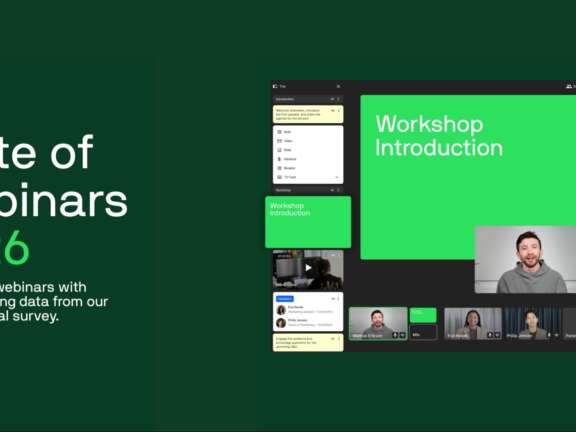
State of Webinars 2026 - Launch
We’ve crunched the data and the findings are ready... tune in for the launch of our sixth annual State of Webinars report, the world’s most comprehensive analysis of webinar trends. Every year, we survey dozens of global companies to gather insights into how their webinar initiatives are evolving, then we share the data to help you make more strategic decisions about your webinar program.
Category
WebinarsView transcript
Hi everyone and welcome to this Webinars, on the state of Webinars,. 2026, my name is Steffen. I'm one of two co-founders here at Train to Free, so I spend a lot of my days sort of building out Webinars, stuff. we're building video software with our engineering product teams but i've also been sort of in the quagmire Video, communication and Webinars,. and a lot about the data and the progress that we've seen. and I've sort of been in the trenches of that for the last... well better part of two decades so in that sense this is usually one of the hallmarks or milestones or even one of my favorite Webinars, of the year this is when we start talking about Not only that, can you do with Webinars,? Now it's all those kind of things, they come, but also taking a bit stock of how we're progressing as an industry. So that's basically what we're going to do for the next. well, 45 minutes, 50 minutes, something like that. And I'm really excited to see a lot of people. sort of hanging out in the room here to... to start going through this. First of all, I know there are people that might not know TwentyThree, ahead of time. to give me two minutes to just give you a bit of an intro to what we are. Screenyfree is a European company. We are the only global player in Video, marketing software. Meaning that we're the only company out of Europe that is feeling a full product suite that crosses everything from video marketing, Webinars, marketing, Video, production in the browser Personal, video. This is something that we are really proud of. from a product perspective, but I'll also say that we're really proud of the teams that are using it. So we are seeing a lot of. different adoption in different spheres all the different parts of them of the stack. We'll come more back to sort of how people are using Webinars,. Are they Marketing and sales? How do they measure whether that's... successful but from TwentyThree, perspective we're essentially excited about seeing a lot of different companies coming from, well, the startups of Europe to the top performers of our industries. already kind of using the engine TwentyThree,. to run Video, and Video, marketing. We have a bunch of different products that are part of the all-in-one product that is TwentyThree,. People can use us Video, Marketing we host Video,. We launch the landing pages, their Video, hops and run a lot of the. the kind of Webinars, Video, and all the data that goes behind that. We have a full Webinars, Platform, mean, that's relevant for everyone in the room here, if nothing else, because you are in TwentyThree, Webinars, room as we speak. but also sort of the product that allows you to run Webinars,. not only while you're live, but before with... all of the transactional emails and the signup pages and the data and the integration with Marketing automation. during the Webinars, for producing the right Webinars, that's On brand feels right, has the right amounts of firm. of interaction and then finally also after the Webinars, over with for on-demand viewing again emails but also a bunch of tie-ins to the rest of what we do with AI augmentations to make sure that you are accessible on brand, but also that you can reuse Video, after Webinars, over. We have Video, library product. and that allows everyone on your team to get access to Video, content something that feels banal, but it's really crucial. as you're rolling out Video, for a strategy in your company. And finally, we have Personal, video product tied into all these things that allows everyone in your company to record Video, really quickly but also record with their colleagues Assigning tasks and automating a lot of the things that go into video production. particularly for all those videos that wouldn't be made. if it wasn't for the fact that it was quick and easy. one click in a browser. As you can tell, I can talk about TwentyThree, day. I have. Trust me, if you've ever met me, that's... that's part of the pitch. We're really excited about what we're building. If you have more questions. Well, come ask us, talk to our specialist team. and so on, we'd really love to... sort of figure out what you're looking for. how we can help fit those needs. That's not really why we're here today. We are here to talk about the state of women. So. This is our annual survey where we... We go and ask a lot of you guys and a lot of Webinars, producers. to tell us how you're using Webinars,, how you're scaling Webinars, in your organization. What are your favorite formats? How do you measure success? How do you integrate? Webinars, with the rest of Marketing stack and a lot of other things that tie into that. We marry all that data, not only with the the survey responses, but also with insights drawn from our Platform,. We see Summit, the tune of 5 million people joining a TwentyThree, every year. and obviously we know a lot about sort of What does it take to turn them out to the Webinars,? What does it take to engage them during the Webinars,? How are people? people evolving their strategies for doing so based on the data that we see. So the State of Webinars, report is our annual So, boom. I want to say benchmark. or even just snapshot of how the industry is doing at the moment. So that's what I'm going to do now. This is an annual document so you can see us having done them. I think from 2020 onwards. You can find the old documents out there if you want to. see how the benchmarks are doing, how the Spots, have been evolving. But what I'll do today is... I'll introduce you to some of the parts that we're talking about in the report. The report is available on our website. I'll share a link and all that kind of stuff. but for now I basically want to take you through some of the 2nd and some of the questions that we've been asking ourselves and everything from Our Webinars, are going about in the organizations. How can we see Webinars, turning from tactical one-offs into strategies? How are people evolving their Webinars, formats? And also sort of how does that fit into budgets? How does that fit into? content generation and what are the benchmarks that you can use. Hopefully By the time that we're over here, feel free to ask your questions come with your comments in the chat all those kind of stuff but But hopefully by the time that we're done here, you'll have gotten a bit of a primer. to figure out how can you measure whether you're successful and hopefully you've gotten three or five or more ideas of of how you can Keep developing your Webinars, strategy. That's at least the mission statement here. So that's one thing that we can see when we look at the data. This is sort of the year that companies get serious about Webinars,. Webinars, is not really kind of this one-off thing that runs in a whatever, in Video, conferencing tool and you send a link and you can sort of join. people are getting increasingly... professional and serious about what they do and they do that Not to look better, it's also that, but also because they can see results coming from Webinars,. So we can see a lot of those small triggers of scale. Some of that is how do we build our teams? Some of that is how do we use templates or even Webinars, series to make Webinars, repeatable. And some of that is knowing that Webinars, Platform, are not just working in their own sphere. but rather working in conjunction with a lot of other tools. So that can be... having whole response data be available in your CRM system. So all of those different signals to seriousness. or professionalists we're kind of seeing those and i think from TwentyThree, side we can also see when And we get a, whatever, everything from somebody saying, Hey, we're looking to do a Webinars,. in a month or so up to very formalized RFP processes. we can see people have a much better sense of what they want to be doing with Webinars,. It isn't just a... tool that might be fun to try out. Rather, this is something that they want to be building their businesses. All right, so if we start out by looking exactly at that Webinars, within organizations. and Webinars, are this kind of flexible thing. It's in a lot of cases just standing up in in front of OnCamera, and going live and talking to an audience. So it's sort of a... It's an opportunity to be very creative within a very simple format. But we can also see that The journey isn't just starting small and then doing a bit more, but rather that the scaling is happening in real time. Almost half of organizations run more than one Webinars, month. This is actually a metric we've been tracking over time. and it's sort of important because it actually is It's sort of at the cusp of being something where people... have kind of started out we might be doing one Webinars, might be doing two Webinars, But when we're looking at it now, this number keeps growing, the number of Webinars, that are being run by an organization. to now be more than them. to now be more than 10 per year. And it's not that 10 is a magical number. I mean, it might be, it sort of figures out how it... how you kind of use the Webinars, in a calendar year so there might be magic in the number of digits we have on both hands. But this is a number that's sort of been trailing up and up every year. So we can see the materialization. This is not about running the same Webinars,. every month but rather to have a bit of a more mature strategy in terms of what are the Webinars, that are being run. We can also see organizations More than 10% of respondents that run more than 50 Webinars, a year. and even a slice of people that run more than 500 Webinars, in a year. That requires a very different... kind of scale of organization but that's also materialization step This is a way where we can see. fully fledged video strategies or Webinars, strategies. that aren't just about sort of one or two people in a team, one studio. but this becomes more about how do you do a global rollout. across different business units, across different geographies. that allow you to run Webinars, there. So if you take one thing away, it is that there is... a steady rise in the frequency of Webinars,. which obviously is good for our industry. but it also highlights some of the challenges that will come up as you go from producing a few Webinars, to figure out Okay. I can measure success in this way. When you have twice as many Webinars, or 10 times as many Webinars,. those measurements probably need to be automated. different ways so it also presents different challenges for companies as they're going along. This is not a fair. Right. We. You can see that most of the organizations that are are sort of going from the left-hand side in this sphere. "Hey, we're running a few Webinars, into running..." 10s or even 20s of Webinars,. a lot of them actually have been running Webinars, for more than four years. So it's also a steady maturization of the of the industry where you can see that there's a good shot of people that have actually been running. We've been asked for a decade or more I should say. So this is also a healthy part of the industry. These numbers are trending up. I want to say that there's a slight There's a slight kind of deficiency in figuring out who are the new newcomers to the field, we can see that the newcomers are maybe the more innovative. ones they're the ones that come in with a bit of an eis land with a bit of a different production methodology but the materialization of the industry It's certainly that it takes a few years to get to a point where you know exactly how to do this. Another way of measuring that exact same thing. is that more than a third of organizations have dedicated people. that are part of setting up Webinars,. So that's going to be a dedicated Webinars, Program Manager. or even a dedicated Webinars, team. You can kind of see that on the right hand side here is the 17 percentage points and the 19 percentage points. instead half of our organization spaces and hey we have a shared process across teams It might be Marketing team, it might be the comms team that are running the Webinars,. But again, this is a slow shift, but one that is consistent year over year. that the people that don't have a specific setup that's sort of trending down the move there becomes okay we actually have a process it's sort of going into Teams, but there's a steady rise in in particular cases where there's a dedicated Webinars, team. And again, that goes hand in hand with being able to run. more resilient Webinars, programs beyond. 10 or 20 Webinars,. The reverse of that is also that We're shying away from cases where there's only one person that can go OnCamera,. This is the most kind of... frequent question that we've been asking of people. I've been... doing product work for an upcoming release TwentyThree, and we've been visiting sort of Webinars, studios because we're looking at how we can do more branding in the Webinars, room more of all that to come that's not the announcement here and we've been talking to a lot of Webinars, out there that have very detailed setups for like how are your OnCamera, running? How are you doing? lower thirds? How are you running the branding part of it? Webinars, how are you Setting up Webinars, for running with it. And the trend here is that there are still organizations out there where there's only a single person that can. We're seeing again the same steady move that we can see in terms of having. more teams that do things, more... or M. more capacity to go higher in terms of the number of Webinars, that are being run. There is also a rise here, particularly, I want to say, in the 63% number here. So the 20% number on the five or more people that can run a Webinars,. That's been steady for a few years, but the shift from having just one person into having a few people that are capable of running a Webinars,. is something that has shifted just between last year and this year. Okay, I want to say that this might be also one of those kind of red flags. that we can all sort of look around and see. how good are we at scaling Webinars,? an organization we really want to be scaling Webinars, we want to be talking to to more leads, to more customers. We probably want to have kind of partner-specific Webinars,. We want to have product-specific Webinars,. We want to talk to... kind of all of those different then audiences that we have as a company. It's not hard to dream up those particular formats. It's not hard to say, well, we want to have onboarding women. I'll save it two weeks or we want to have a an annual launch for a new product feature and sort of all the things that go into that. But a prerequisite of being able to do that is the resiliency. not necessarily in terms of having exactly four people or five or more people. I can run it but having different ways of producing different kinds of Webinars, and having that be democratized. That's essentially what we see happening in a lot of the organizations that sort of crossed the chasm. the chasm of being able to go from 10, 20 Webinars, and being sort of... constraint on that one to having mandated people being able to go live. Not necessarily just in the studio, but also from their desks. Not necessarily just one locale. but throughout the company. Those are the people that sort of cross-activity. across and set enough guardrails for this is how we want our Webinars, to run this is how it should look might have the capacity to all the centralized resources to promote those Webinars,. but being able to run a Webinars,. is a skill that needs to scale, not to just being a single person. But you're being a lot of different people and I can... and sort of say that's something that we've been doing TwentyThree, as well. I probably am one of the ones running the most Webinars, here. But this is also a case where we're really trying to get. More people in front of the camera and also more people behind the camera. It's a time investment. This is steady year over year. And I actually would have thought that the time investment that is put into Webinars,. that would go per Webinars, down. over time. It might be that people get more ambitious in terms of how do they prepare Webinars,, how to do rehearsals. How do they promote Webinars,? How much copy do they write ahead of time? of a Webinars, to sort of spend these hours differently. And that might be a follow-up question from this one. But you can sort of see that, hey, not a lot of people are spending more than 20 hours running a Webinars,. But the mixture here in how many people are spending just a few hours versus It's quite a lot of hours, up to 10 to 20 hours on every Webinars,. This is another case where There's no truth, right? It's not that we want to say, hey, you should only be spending an hour on a Webinars,. That's really tough as well because you need to do the Webinars,. and all those kind of things. But behind these boxes and behind understand there is a lot of That's kind of a challenge I'm going to say for organizations to figure out. what are the kinds of Webinars, that we want to be doing quickly. where successes, we did the Webinars,, we had eight people on it. What are the Webinars, that require a different kind of success metric where We want to be spending 20 hours. We want to put money behind it in terms of promoting on. on on digital channels. We want to... spam our base, we want to send an email to everyone. on Marketing lists. and we want to maybe put five people on stage for a panel, all those kind of things. A lot of this is It's problematic if you don't have a Platform, this ahead of time. knowing how much time you're prepared to invest in a Webinars, before you start that Webinars,. is crucial in order to secure the scalability and the success ultimately of the Webinars,. If you're spending 20 hours on a Webinars, for There are eight people that are not leads, and there's no necessary pipeline for that. That might be good, but it's harder to justify. On the other hand, if you're spending too little time on those very valuable Webinars,, you might not be getting the most out of it. So this is sort of a tool of figuring out So for this particular format, how much time do I want to put in? How much time do, like, how many people do I involve in it? and how do I do the promotion for it. Because ultimately that's sort of what we're finding is that that the people that are running Webinars, are increasingly seeing the Webinars, as important. right the number here of extremely important sort of stable over time is like one in five of the Webinars, producers that answered our survey they see an organization where Webinars, are the primary communication. pipeline for their company. So this is extremely important. But the very important bit here is seeing kind of... slow uptake over time and that's because we're proving that Webinars, are crucial to bridging that upper part of the funnel where you don't really know who people are. to further down where you're selling to people. Webinars, this massively amazing tool that is flexible and you can do different kind of things in front of the camera. that allow you to transform people that... that are sort of widely interested in what you're doing. to make them more interested as you go along. So it's a crucial part Marketing. Hence also why Webinars, become increasingly important. So what are the impediments for doing more Webinars,? Well, time. Time is one of those, right? So when we ask people, why wouldn't you be doing Webinars,? The biggest problem in producing a Webinars,. Interestingly, it's not really about complicated software or even Video, gear setup. while those are important bits. they're not necessarily things that... that hold us back from running that next Webinars,. It's really about the amount of time it takes. And I think I gave an okay tool for sort of thinking about the amount of time it takes. the amount of time that it takes to run a Webinars, in the back of your mind or in the back of your boss's mind is always the same. then this becomes an impediment. If you don't have that idea of flexibility in terms of the time investment that you're making, well then it becomes really hard to to figure out how to how to justify different kinds of women. And then... the more human part. Are we hosting Webinars, in an engaging way? Are we creating the right content? or we're finding the right speakers. not a lot of friction here right these are kind of number two three and four on the on the things that are kind of holding people back from doing more Webinars,. We're also seeing that these are mostly about figuring out reasonable formats, having the right people and having more people. to be involved in the setup. So lot of really nice kind of insights here in terms of of what is holding you back. but really kind of the amount of time that it takes. That seems like the top one year over year. And a lot of that is figuring out how much time do I want to spend? What is my time budget for a particular Webinars,? and then figuring out whether you can make compelling setups with that. Of the respondents, 11% asked that we... ensure that we're lacking an actionable strategy. We have Webinars,, but we don't really have. an actual strategy for how to to run the Webinars,. This is something that But kind of as an aside, we've been looking at a 23.4. the past few years and we sort of scaled up our internal capacity. on how do we do acceleration of... strategy creation both Video, and for Webinars,. because we are We're an industry where it's not hard to justify why you would run away. It's not hard to justify Video, and Webinars, make up more than half. of engagement on people's web channels, but it's maybe hard to attach that. slice of engagement to a clear strategy. and something that kind of traverses the organization to a point where it's not just that. If you can see this value in Webinars, too. we have an actual strategy of how we release the EM. potential. So why are people running Webinars,? For the most part, they're running Webinars, to educate customers. and to generate leads. So this is sort of like-- 2 out of 3 that answer this question, they'll have said: kind of either one of those things or actually both of them right so So educating customers, this becomes a very low funnel. exercise to say, well, we have all these customers that might be using our products or... that we want to be keeping engaged with. and Webinars, is the main, sorry, is... is a crucial part of doing that. That's why we run Webinars,. Then generating leads is the next step. becomes the exact reverse, educating customers. That's a lot about communicating to people that you probably already know them. let you know their names and their email addresses you're doing ongoing efforts to keep them attached to. your company and to your product and all the things that you're doing. Generating leads is about sourcing those people. So generating leads is... It's about getting that email address, getting that name. getting that contact point and starting to move people from the top of the funnel and further down. I worry about showing this slide and I've shown this slide for a few years running now. that these are the two main parts of what people are identifying. as the dominating reason. for running with. I think a lot of the other ones are, hey, how do we do on board? How do we do internal training? How do we do... branding how do we like all those things that are natural parts of the mixture of Webinars,. I think there's a huge value in saying that. that you can absolutely use Webinars, for educating customers and you can absolutely use it for generating leads. I'll even say that Webinars, are amazing for doing both of them. but it might be worth picking a lane. So if you're not one of those organizations that... sort of are out on the side and doing VideoDays, or even... 50 to 100 Webinars, every year. It might be worth not saying we only do this to generate leads. So we only do this to generate. to educate customers. but rather figure out which of the one is important for any particular Webinars,. It's very hard to produce a Webinars, that... does both of them at the same time. So it's worth saying... - Well, this Webinars, we're doing to generate leads. or this Webinars, we're doing to educate customers. So when you're setting out your strategy, you sort of want to make sure which of like how much weight. you put on either leg. You're not going to be standing on one leg at all times. but you sort of want to be balancing out and making sure that you know exactly. kind of what you want to be doing and that's part of a meaningful strategy for Webinars,. then This also feels natural once you look at it the first time, but there's also a... an insight here. We're seeing year over year more resiliency. not Marketing teams using Webinars,, because Marketing are the primary users of Webinars,. followed directly by sales. But what we're seeing are year-over-year percentage points uptakes. in the proliferation of Webinars, in the organization. So using Webinars, and recruitment, using Webinars, and design, using Webinars, to power events. those are seeing steady rises year over year. And again, that's a part of figuring out what are the component parts of your strategy. I just want to say that again, there's no truth in this one. It's very interesting to kind of look at. How are people seeing this? Is Webinars, something that is... a crucial part of account management and customer success. I think it should be. I think there's a really resilient play to be made there. But you also want to be, again, balancing out and making sure that your strategy efforts identify. Where do I want to start? Is this my first priority to do Webinars, in my customer success? or am I... doing well basically first priorities Marketing. And it mirrors basically what I said before, right? This idea of of figuring out educating customers versus generating leads and finding that balancing act. of knowing which Webinars, you're doing for which purposes. and identifying a meaningful strategy for it. These are a few highlights of how people have weighted their teams, weighted their efforts, identifying what the purpose is of the area. of a strategy. Again, we're doing a lot of work with customers and with the market to start the strategy generation process for this. So if you are interested in figuring out sort of well double clicking on some of these or figuring out hey how do we gauge What is the right thing for my organization? and he would love to talk to you. Or we have a lot of tools also on our webpage where you can sort of... self-identifying. How can you at least find the beginning questions of a meaningful Webinars, strategy? I want to move on a bit though to talk a bit about Webinars, formats. So the starting point for any Webinars, company is that you do the first Webinars,. So you basically say, well, wouldn't that be an amazing Webinars, we're going to be doing? kind of talking about this product launch or we're going to do this thing for a partner. So the one of Webinars, becomes the entry path. into all Webinars, strategies and that becomes kind of the... whatever the foundation that you can stand on and start building out. strategy, more practice, all those kind of things. But we're also seeing that there's a move from ad hoc sort of the online seminar where you can do a thing. into more resilient strategies where... The standalone Webinars, are absolutely happening. And they're happening in every organization with extremely few exceptions. But we're also seeing more and more sort of episodic Webinars, happening. So that might be the cases where you're running sort of the same content series for the same audience, but with different content every time. So think of this as being sort of... new practices for AI or for design or for Webinars, or whatever. But episodic Webinars, where you're sort of building for the same audience, you might be hosting a Webinars, every every few weeks, every month, but basically building your audiences. What happens a lot here are people that are doing short 20 minute briefings, either weekly or monthly. about their industry. So that could be sort of the financial market updates or it can be pension updates or anything sort of in that knowledge sector as well. This arises well in online digital events. So the longer format Webinars,, where the Webinars, format, this idea of actually signing up. actually having its activity, actually having having having online participation mixed with events. That is seeing, I want to say, only a few percentage point riots. But what we are seeing is actually... a sort of a trending up in repeating Webinars,. This was a lot less, like less than half. Last year, so this repeating Webinars, square. people running not the same Webinars, again and again, but that onboarding Webinars,. So this feels like a new way of sort of getting your strategies in place and the formats that that mirror those. What do you put in your Webinars,? What are the different formats that you want to be picking? I think this is an interesting chart. You can sort of see some of the same pictures that I painted before. in this one. But there are a few ones in here that are interesting. sort of the proliferation between the lead generation down to to what are the channel Webinars,, what are the internal Webinars,, what are the exclusive Webinars, that you're doing? you're scaling out from doing that first Webinars, to those first Webinars, to doing 20 or 30 or even 100 Webinars, a year. The way of going about that is not saying, "Well, I want this many Webinars,." Rather, it's figuring out what is the mix of different formats I want to be doing. Do I want to be doing some Webinars, with my partnership channel? Do I want to be doing... some recurring Webinars, by my customer team. Do I want to have four Webinars, that are product- So sort of finding that mix and figuring out how that mix works. The real challenge is not about identifying new formats they can do. but sort of narrowing it down to say, well, So we have, let's say, four different Webinars, formats that we're doing. We're splitting them out over different teams. And we're assigning specific KPIs to how we can measure success. what would good engagement be? What would good sign-up rates be? in these particular things. I'll come back to sort of measuring engagement and kind of having actual KPIs that tie into all this. This is crucial also because those KDIs will differ by the different formats. So a thought leadership Webinars, going to be very different from a lead generation Webinars,. in terms of what you can expect from it. from business value or even from KPIs. So knowing sort of these are the X amount of formats that we're doing and this is how we measure them. It's crucial, just as I said before, the difference between communicating to customers. and communicating to newly identified leads. is vastly different as well. All right. So one of the main questions that kind of you get when we start digging into data. is the, when should I have my Webinars,? And I'm so happy today to be coming to you on a Friday afternoon. because we have fallen prey. We've spoken about it. the state of for a lot of time so if you see previous state of Webinars, report that you've seen You'll have seen me apologizing for doing a Webinars, on a Tuesday or on a Thursday. because that's when people do Webinars, and that's sort of what we've been doing as well. So when should I have my wind arm? Well, the starting point is certainly people have answered that with their feet in the sense that most people are having Webinars, on Tuesdays, on Wednesdays, and Thursdays. So this is across. thousands of Webinars, across millions of participants. and looking at the shot of it, you can see. less than 10% of Webinars, happen on a Monday. Less than 10% of Webinars, happen on a Friday. And then the bulk almost. whatever. I measured up, it's cool. Will that be 83%? of all Webinars, happen sort of in that bulk in the middle of the There are a few on weekends that are sort of the outliers, at least for the purposes of what we're talking about. as well, but people tend to have wins to have. midweek Webinars,. and You could ask why, right? Is this because you assume that people are more likely to tune into a Webinars, on a in midweek or is this because they're more likely to... to stay around for longer, maybe the assumption is that people won't stick around on a Friday. Well, the data answers that as well. So what is the attendance rate of a Webinars,? by different weekdays. Well, actually Tuesday and Wednesday Webinars,. have significantly lower attendance rates. than Webinars, hosted on Mondays and Fridays, also on Thursdays. So you can kind of see that at least if the assumption is that people won't turn out for a Webinars,. in the beginning or the end of the week. people, well, have again voted with their feet and said, well, that's not the end. That's not the case. The other part of this might be... be kind of looking at the at whether people are engaging because if you look just at whether people are turning up to a Webinars,. You would actually go for first days or Fridays. And Oh, did I lose a slide there? Short version is engagement is sort of the same thing, right? The same. numbers hold up for the engagement rates. that you can see that engagement will be. exactly the same pattern. Did you find it, Cecilia? Cecilia is sitting behind the computer here. frantically looking for the slide that I just told you that I lost. I only have 70 of them. We're not going to run out of content here. What I want to be saying, though, is that... Answering this question would be I want you to have a host in my Webinars,. It's actually fairly easy because people tend to... to host their Webinars, in the middle of the week, there's a lot of congestion for those Webinars,. if you're likely to find Personal, watching a Webinars,. Well, they will have other options, I guess. but also there's no pattern saying that people won't show up for a Webinars, on AEM. on a Monday. So you absolutely want to make sure that... that you sort of... Find different pathways for running the Webinars,. And this is also the case that people are. hosting Webinars, in the morning as well. Wow, yeah, I actually found it, cool. the whole ordering stack here is perfect. short version You want to be having your Webinars,. on Mondays and Fridays. And you probably if you're looking at being different from the rest of your of your work. competitors, you might want to shy away from bullying. I know that it might be that mornings are sort of the well you're coming in fresh you're sort of assuming that this is where i get my get my work done but that might also be what other people thinking. So that exact same thing holds that. there's nothing to to hold you back from doing Webinars, at different parts of the day. and the numbers will show that both the attendance and the engagement rates actually outperform. Both mornings and Tuesdays and Wednesdays. when you look at them. when you look at it from a data perspective. Wow. I hope that made sense to you. It almost made sense to me. If nothing else, you can download the report or you can reach out and you can ask. So apologies for my kind of scrambling slides here. Again, there's a lot of them, so we won't run out of content. I just want to say that. There are compelling reasons to move beyond sort of the default of having your Webinars, on a Tuesday morning, we can see that's... where people do it the most. but also why I'm excited to finally have gotten ourselves to host Webinars, on a Friday afternoon. And I hope your attendance and your engagement here will will line up with that. All right. Time to talk a bit about not just a window. Like, what are the Webinars, that we're doing? Who are we hosting? What do we want to get out of them and how do we scale them? them organizationally in the team. Now let's talk about kind of what are the the actual KPIs to... to figure out whether a Webinars, is successful. So when we ask people, how do you measure success? Like, what is the main thing that you look at to figure out was this Webinars, a success? There's a shot that haven't defined success and I think that's amazingly honest. I'm unsure whether I would answer it. So they would say, well, I don't know. in this way, but it's honest. And I think if we are all honest with ourselves. that slice on the right there, that's 7%. In a lot of cases, that should be all of us. We haven't necessarily just decided on what success is. Success can be we have great speakers. Success is our Webinars, landing pages look great. success can be hey we had a really good Webinars, and We spoke about exactly what we wanted to do. We looked on brand. We had a lot of people, all that kind of stuff. stuff, right? But Having clearly said how do we rate the different metrics that we can get from a Webinars, and say this is what we're shooting towards. I think... I mean, I can talk for us, it's free, but I also get that sense from a lot of people. people out there that this is pretty common that that the Webinars, are magic because there's a lot of data like we know how many people signed up We know how many people turn up for a Webinars,. We know how many people... engaged for how long, we know whether they answered polls, we know all these things. We know how many leads we generated. And there's a tendency once there's a lot of data. to sort of look at all the data and say, well that particular metric was good so it was a success. The challenge I think for everyone here and certainly for the people that want to scale up ...the Webinars, is to figure out for this particular format... Let's make sure that we know what we're targeting. I want signups. Signups is... about figuring out the right hook for a Webinars,, the right title, the right description. In a lot of cases, the right Webinars, trailer. the right promotion strategy on social media or in your own email channels. Making sure that Webinars, available on the webpage. We want to optimize. Specifically, how many people do we get? signing up. A version of amount of sign-ups will be qualified leads generated. Those are sort of the same. I mean, that's obviously... a case where you get a lot of signups, but they're not qualified leads. So there's a... There's a part of that figuring out what you want to be doing. but I want to highlight again here that Optimizing for amount of signups might drive you to watch during different kinds of Webinars,. And that's probably the Webinars, you want to be doing top funnel. So a Webinars, top funnel is something where you want to be driving the channel. You want to get... new leads in and you want to make sure that you can engage them. in a way that moves them slightly down your arm. Another metric would be number of hits in these. So that's slightly further down the funnel of a Webinars,, right? It's not about... how many people signed up. You can have a few hundred people sign up to a Webinars,. and 10 of them turn up. That might be okay if your co-metric was getting people to sign up. Getting qualified leads. In fact, it might be okay. If you're optimizing for number of attendees, your strategy is slightly different. Like you want to have a deeper relationship with some of the people that are. that are signing up. And in a lot of cases you want to be. producing your Webinars, differently. You want to be saying, You want to be addressing the specific needs of that audience, not just to get there. their leads and their kind of qualified leadness generated. but actually to have people come out. You also want to be activating emails. You want to be communicating to people along the way, but you should probably be doing that anyways. But it's a slightly different Webinars, that you're producing in this particular way. case engagement time the easiest way of upping engagement time is to just run longer Webinars,. So that's a handy tip for you. But... sorry, I want to be saying that engagement time is a different part of of the attendee part. It's also kind of figuring out, do I want to be engaging people along the way? Do I want to be... having people ask questions. I should have probably said that when we started. If you have a question, you can go to the top of the page and you... You can click the questions tab and you can do all those different things. But you can kind of see how the difference between optimizing for A lot of audience interaction versus the content that you're producing the Webinars,. is very different. So if your main... driver is chat activity probably you can't have You don't want to have hundreds of thousands of people on a Webinars,. You probably want to have slightly lower Webinars, attendance just because it creates a different kind of dynamics where If there's a lot of people you don't want to be urging. chat activities and so on. All right. This becomes sort of the starting point of saying, Not necessarily kind of what are people doing. but rather how are they in the back of their minds figuring out this is what is successful. another part of the performance part and I think this is another of of those red flags we should have red flags kind of waving into into these slides is... Not only knowing number of attendees, number of signups, how much chat activity was there. but also having that data in the right place. Luckily, these are going up. right, the half of respondents that have. automated that data collection and know that they have the data In Marketing automation systems, there's CRMs. That has risen from 30% to 50% in the last two years. So we're sort of seeing the traction error. And we're also seeing actually still more people that are doing manual things. in order to collect stuff. and make sure that it actually is available with CRM system. but there's still a ways to go, right? We should be getting to a point where all the Webinars, data, particularly for those one, two, or three key metrics that matter for your organization. that those are automatically available. as a part of Marketing stack. And I'll kind of be the sales guy and say we sell a product that does this. but it's also saying that it's a crucial part of justifying. exactly what you're doing. If you can't justify the Webinars, strategy scaling from five Webinars, to 50 Webinars,. most likely it's because you don't have the data to prove. why you should be scaling that. And if you don't have the data, you also have no way of generating meaningful outcomes. If the people that sign up for a Webinars, are not available in your CRM and you don't have knowledge around how they answer the poll or whatever. be available to your sales staff, you're certainly missing out on something that's almost free as a part of the AEM. of a Webinars, strategy that you're always running. Everyone is running one hour Webinars,. We'll see whether we get in at exactly one hour and like, well, I guess in 16 minutes. But the whole idea here is that Webinars, while this has stretched out a bit over the last few years. Most people are still running sort of half hour Webinars, and then one hour. So again, this is data that's running. again from thousands of Webinars,, millions of Webinars, attendees to see that not a lot of short Webinars, running. I think there's something interesting about that 10 to 20 minute Webinars,. I think there's a gap there. in terms of what you could be doing too. to sort of lower the amount of time that you spend on any given Webinars,, particularly if you're... optimizing for signups or just for attendance. then the commitment of a TwentyThree, Webinars, might be very different. from the commitment of a one-hour Webinars,. But it's hard to break the patterns of the industry where Everyone is expecting for the Webinars, to to be an hour. All right, let's run a few quick fires here. On average, companies will host 25 Webinars,. You saw the distribution of that before. but also we can say that the average duration of Webinars, is 54 minutes. So that's just shy of an hour. and is very much kind of in that middle of the pattern. What I'd love to see is more proliferation either direction. and of the people that they had to provide our Webinars,. The people that dare to run 2-hour Webinars,. The people that dare to run 15-minute Webinars,. to sort of get to that. When I showed the slide before around kind of signups, attendance, all that kind of stuff. Wow, that's communications. My whole mind here is... Cool. Sorry about that. I just... I was just told we have 15 minutes. We're good, we're good. What I didn't show before was... was the focus on-demand part of Webinars,. So the average duration of them. of a Webinars, 54 minutes. the average duration of people Kind of watching a live Webinars, 40 minutes. So it basically means that that if you get people into a Webinars, that's running for roughly an hour. People will actually stick around for 60 to 70 years. percent of that Webinars,. That's massively high. For any other web channel, that doesn't happen. Like it literally does not happen. that people are kind of tuning in to be with your brand, with your content, with your messaging for this long. This number is 22 minutes for on-demand Webinars,. So, the business means that the Webinars, that we're producing now or the Webinars, that you've already produced before. or that you got people signed up for and maybe attended live. and watching for 40 minutes, that has a shelf life that's a lot longer. And I'll step eight slides back here just to confuse everyone. because one part of the metrics that I think is undervalued here is the views of on-demand. So the one third of people that... R.M. that are identifying this as a potential and KP1 Yeah. have seen sort of the fact that Webinars, already exist. We already produced them. They're hopefully great. We already have all the signup pages, all the assets that go with it. We even know how to promote all this stuff on social media. I'm here to tell you that the content that you're producing for 54 minutes the content that people are watching for 40 minutes that works amazingly on demand. They won't stick around for as long as for a live Webinars,. But for 22 minutes, as I said before. people will actually watch an on-demand Webinars,. And it's a massively amazing touchpoint. mainly because it's fairly free or rather It's a like once you've done the Webinars, that evergreen content becomes a... a crucial way of again driving leads driving engagement and telling your story. The Webinars, funnel is also about how many people hit a landing page, how many people actually sign up for a Webinars, how many people turn out for a Webinars, so i want to show a few numbers for these are aggregate average numbers across all the people that are using swing. going free so there this great data but it's sort of something that you want to be be looking at in your own context, it might be that the average number of people that visit a Webinars, landing page for your brand, for your content. is massively higher than this or you mean that it might be that it's massively lower. but it's worth keeping these sort of numbers in mind. So. In the last year, the average number of visitors that hit a Webinars, landing page for any specific Webinars, was just over 500. And from those 500 plus... views of the page and more than 300 people signed up. That is a lot. Like it's a lot Again, I can refer to a lot of online forms that people never fill. Even if you are a great Marketing that has done a lot of work. in figuring out how to get the exact right hook on a landing page. the exact right framing of what can you do by signing up for this content downloading this white paper and so on. Well. Getting people to sign up at a 63% signup rate. It simply doesn't happen in anything that isn't Webinars,. In fact, this number is going up. This used to be 58%. So you're kind of seeing an uptick in the signup rate of Webinars,. even this far into the cycle of people adopting Webinars, and getting expectations of it. So that's a crucial number to kind of keep in the back of your mind. Maybe don't know whether you get 500 people on your landing page or 300 people signing up for a Webinars,. but sort of knew what the sign-up rate that she should be shooting for. If you're way lower than this, it's probably worth to do. if you're way higher than this. Tell us how you did it. And. So certainly kind of knowing this as a benchmark is crucial. people will attend kind of those. 300 and some people, they'll attend Webinars, at a 58%. at Sandbridge. So this is basically how many people of the a huge sign-off list of people at it, how many people can expect it to another? And. Again, there's somebody on the right here. We're seeing... companies that are kind of driving membership. Webinars, that are outperforming these numbers. It's usually because people pay and you're sort of like the number of people that hit a landing page is going to be lower. On the other hand, the attendance rate is going to be higher. But when we look at this more widely, the attendance rate for for any given Webinars, sorted to this tune. And again, it's Summit, be optimizing for. If you're not hitting this benchmark. So how are Webinars, staged for participants? What are the interaction points that people are using? in Webinars,. 65% of Webinars, have chats. 40%, 41% even of Webinars, have reactions. 43% of Webinars, have polls and 66% have questions. This varies a lot and as I said before it actually varies a lot by the size of the weapon. some particular kinds of interactivity. they lend themselves really well to cases where where there are where there's a few attendees. other things where there's a lot of attendees. For example, Polling works really well if you're hundreds of thousands of people. participants, questions maybe somewhere in the middle. Chat is usually something that you might want to disable if you have a thousand participants. But either way, it's sort of known kind of how to mix this stuff. And interestingly, there's no one size fits all pattern here. It's very rare that people are doing all of them, for example. All right, so that was a bit about Webinars, performance and I want to talk. about Webinars, budgets as well. So we're sort of moving back to to sort of How do I gauge not necessarily whether my single Webinars, is resilient and scalable, but how do I? How do I look at my organization? So, a quarter of organizations plan to increase their Webinars, budget in the next calendar year. while basically everyone else is... is planning to kind of stay in the same bundle only six percent of respondents our planning to spend less on Webinars, and this is full circle to where we started out It's full circle in the sense that this is very much a strength, a sign of strength in our industry. in that the Webinars, budgets are either. the right size and allow for a lot of the things that are going on. or people are planning to spend more. They will also plan on spending more on promoting the web. Webinars, than producing them. And this is I think in line with this trend of figuring out how much time do I want to spend. I'll say that one of the main points of pride for what we do at Train Free is that we usually tend to bring down. the time that it takes to set up a Webinars,. creating a new Webinars, using a template getting it to be published, having the right landing page in the branding for that. That should literally be an exercise in 10 minutes, maybe half an hour. before you've written the right copy, picked the right images, all that kind of stuff. and we're building more and more tools to sort of bring down. not necessarily how much time you spend on a Webinars,. are, but how much time you spend on always treating the women. And this allows you to spend more time on all the other bits. on spending more time on promoting the Webinars,. spending more time on creating the content for the Webinars,. and also for... kind of setting up all the things around it right your studio and the team and all that This is another case where three and four saying, well, we'll actually spend more Marketing. promotion this is because Webinars, are working. So in that sense, I can be the pitch man again and say, well, this is actually about not just, well... doing software or setting up the team or that kind of thing. of stuff right it should be that the means that you have right now will allow you to go live run a Webinars, and then spend effort in all the things that that kind of top funnel move the needle for the KPIs that we've identified. State of Webinars, report, well, we have added 2nd in the past few years on and I think it started out with this kind of fundamental flaw in how honestly we, but also a lot of them. other people are running Webinars,. Webinars, are very kind of event-ified. Webinars, become these things where you are looking at We have a Webinars, on Friday. We need to prep. We run the Webinars, and when you click. In Webinars,, you're done. Well, really, you're not. I highlighted this idea of on-demand Webinars,. before, but you also want to make sure that you're using Webinars, as a content engine. So. So. Again, TwentyThree, tools, but this is not necessarily 23 specific. This is about respondents saying that. Webinars, are a crucial part. of content creation this can be about. about kind of making reposting of on demand Webinars,. It can be using the content from a Webinars,. to form blog posts, it can kind of be this virtuous content. creation cycle. And yeah, there are innovative ways of using Webinars, content, everything from video... Clips to social media to using the transcript content to. to feed an LLM, but also to do text content for for your website and certainly kind of even reusing parts of one Webinars, into another. So there's a lot of potential upside. It's not just looking at the Webinars, being done. Checkmark. but rather saying that there's evergreen content. that can live both on demand, but also as a source of more content down the line. We're coming to the end of this kind of... of the long idea of the benchmarking part but i wanted to highlight a few a few points here as well. First of all, we spoke a bit about this kind of average signup attendance rate, all those kinds of things. I think all of that is in the report. And this is not about over saturating with a lot of content. That's not the point, but it's about picking. what are the things that I can benchmark myself towards. Am I getting my conversion rates on my landing page correct? Am I getting the right thing? a 10% rate and I'm not converting people on my on-demand. I won't say too much more about this. It feels like we've been here. But it's really about kind of challenging people to find that right sense of them. of picking one or two metrics. that you can go and see was I actually successful when my Webinars, up Highlights, Webinars, are growing important. More than 62% of respondents see Webinars, as important. are extremely important as a part of the digital strategy. There's still a disconnect that this strategy might be sort of missing and some of the KPIs might be in. be missing but nevertheless women I have never been more important than they are today. People are making their Webinars,, they're scaling their Webinars,. but Roughly 30% of respondents are still not using Webinars, as a source of more content. This is something that is untapped in our market and I think something that... Really interested to see both improving. but also to move the needle on them. next few years. And then yeah, there's a role for the Webinars, producer that's in the rise. with about 30% of respondents having dedicated people or teams for Webinars,. So some of the highlights for the state of Webinars, journey. So that is me throwing a lot of data and a lot of stats at you. Thank you for your duration. What's really cool about this is that the state of Webinars,... The report is out now and you can find it on trainfree.com/state/off, whatever Webinars,. The link is on the screen, but you can actually also see it in your chat. and click the button there to get your copy. So this is our sort of snapshot of where we stand as an industry now. getting all the numbers that I spoke about now. But also, if there's something you're missing, we're doing this every year. So please reach out and say, hey, wouldn't it be nice if we added this to the report? Or, hey, this doesn't work for my organization. how do you see these numbers for this particular sphere? Then finally, this is a conversation that's ongoing. We are TwentyThree, hosting the world's largest conference Video, and yes, also on Webinars,. at TwentyThree, Summit, hosted in in Copenhagen in the end of May. And this is an invitation to come actually continue this conversation. This is sort of the case where you have Video, your job title or even not but you're just interested in all this stuff It's a two day intensive conference dedicated to everything that we've spoken about here. whether that's about data or about storytelling. We have a jam-packed program and we have... a quick venue so we are moving if you've ever been at the training for yourself before They have been Summit, going to be more awesome this year. since we are taking over the DR concert hall. to be able to host more people. and more condescending. If you're... traveling into Copenhagen. We're also hosting a Copenhagen experience, which is going to be All the things that happen around a conference. And so if you're talking to your boss, you might say, I'm going to a conference about video. But if you're excited about coming to Copenhagen to... to join the team, join the conversation. and join the, whatever the exciting conference. This is also an occasion for you to to join the Copenhagen experience and get to see our city. with a lot of the people that are also attending. Because you stuck around in the Webinars,. There's an exclusive offer just for the people that attended the state of Webinars,. That's you guys. So thanks for being here. being with us. We'll post a link in the chat now as well. So if you want to go... go get your ticket, you can head over to trainfree.com/summit. This will get you entry to the Summit,, breakfast, lunch, people, curated the Copenhagen experience. but it's a way of continuing this particular conversation. There's a 50% discount if you sign up. with the discount code TwentyThree,, state of Webinars, 26. Thanks. With that, I will leave. We fall into the trap of doing. exactly a one-hour Webinars,. That's what we were shooting for. That's all good. We've also... So avoid the trap of running it in the middle of the week just along everyone else. So I hope you appreciate it both that we were exactly as everyone else. but also that we were a bit different. I really hope to see you at TwentyThree, Summit,. I really hope that you had a good time here. Thank you so much for joining and see you next time.


