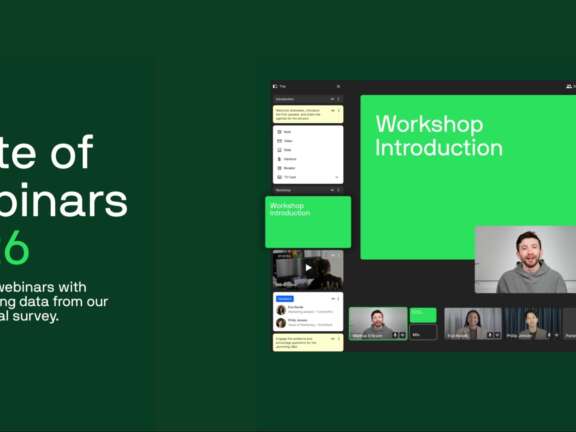
We’ve crunched the data and the findings are ready... tune in for the launch of our fifth annual State of Webinars report, the world’s most comprehensive analysis of webinar trends. Every year, we survey dozens of global companies to gather insights into how their webinar initiatives are evolving, then we share the data to help you make more strategic decisions about your webinar program.
Unlock the webinar
Thank you for signing up

You are signed up for this event.
Unlock the webinar
Thank you for signing up
You are signed up for this event.
View transcript
Stas. characters. reagupona.com. Thank you. Thank you. Thank you. Thank you. Thank you. Thank you. Thank you. Thank you. And this year is a bit different because, as some of you may have noticed, we have a very specific theme, Webinar Scaled. and we're going to be exploring just that. So why is it important to scale your webinars? What does scaling of webinars mean to you and to different organizations? How have some of the world's greatest brands already greatly succeeded with this? And yeah, that are some of those interesting questions that we're going to answer throughout the program for today. But we also had an amazing lineup of sessions yesterday. So let me quickly show you what you missed out on. If you were not part of day one, we had sessions about webinar scaled, a powerful keynote by Thomas Mattson McDill. We had scaling success stories as well as scaling webinar strategies. And we wrapped up the day with webinars today with Anne Handley in a fireside chat with our CTO and co-founder, Stefan Fagerström-Christensen. So if you feel like you missed out on any of the amazing sessions we had yesterday, then please remember that you can catch the sessions on demand. So feel free to share with a colleague or a friend if you think any of these sessions could be useful to you and your team. But that is not why we are here. We are here for the sessions going live today. And if we can bring the agenda up, I would love to introduce you to the state of webinars. Report launch is going to be happening right now very shortly. It's always an audience favorite. You get a lot of interesting data points from this session. Then we're going to be moving on to an interactive panel discussion on scale your webinar formats and follow that up with a scale your webinar audience session with Lev Kerb and some reflections from a journey scaling webinars with Lasse Höfels. Are you excited? Because I can tell you that I am. We'll be exploring how webinars have been breaking out of the marketing department and really helping companies connect with their audience throughout the entire funnel. And I hope that when you have consumed webinar days that you will feel equipped to scale your webinars in 2025. I just want to do a quick introduction of the platform. This is your first time in the webinar room. To my left here, you have our chat feature. This is a great way for you to get to know your peers. Like I said earlier, let me know if you were part of webinar days yesterday. What was your favorite session? Any highlights? Anything you learned? What were any takeaways? That would be really interesting to get some insights on. And I also want to highlight our questions feature at the top of the chat. Please ask your questions. To the speakers using the questions feature. This way we're able to bring your question on screen and it's a really good opportunity for you to get your questions answered. But if you feel like that's a little bit too intimidating and too personal, you can also use our reactions feature just down here at the bottom of the chat. I know we're not sitting together physically in the same room, but I really hope that we can come together as a community and learn from each other. And grow together and help inspire each other. So without further ado, I would like to give a big thanks to all of our speakers who are going to be contributing with their insights throughout yesterday and today. You're going to help hundreds of marketers improve their webinar efforts. And thank you so much for taking the time. But without further ado, I think it's time to get into it, shall we? To announce this first session to you. We have crunched the data and we are ready with some findings. So tune in to the annual launch of the fifth year in a row State of Webinars Report. It's the world's most comprehensive analysis of webinars and webinar trends. Every year we survey dozens of global companies to really gather insights into how their webinar initiatives are evolving. And we share the data with all of you so that you can make better strategic decisions for your webinar programs. And in this session, we have CTO and co-founder Stefan Fagerström-Christensen. He, as co-founder of Europe's only global video software player in this space, has been pioneering in the MarTech landscape for decades. So he really knows the data. He has the experience. So please feel free to really rack his brain for those insights. So let's see if Stefan is ready to join us here. Hi, Stefan. How are you doing today? I'm doing fine, Amelia. Thanks for having me again. Yeah, thank you so much for coming back day two. We're so excited for this session. So the screen is yours and please take it away. Thanks so much. So I learned yesterday that on demand is something that you want to be sort of stingy with. In terms of like when do you want to be doing it? Do you want to be making people actually watch live in order for seeing the on demand? As a lot of, well, tricks and, well, intros to the trade of running content marketing and webinars. And I'm trying to figure out once we start looking at the data side of that, whether that coheres. So that's what we'll be doing for the next half an hour or so. As Amelia said, I'm Stefan. I am one of two co-founders here at 23. I spent my day doing kind of engineering product work. And building, well, amongst other things, webinar products. And in a lot of cases, that becomes about kind of user facing features. This idea of like, do we have compelling ways of running Q&A? Do we have great chat? How does video quality work? How do you switch between speakers and all those kind of things? But one of the things that we have been building for the last, I mean, maybe not two decades, but pretty close is analytics. So the analytics engine that will allow you to know kind of where is my video playing? How are people interacting with my webinar? And what we do every year and one of the things that we're quite excited to be doing, and we just said it a fifth time, a fifth year running here is to compile some of that data to see kind of how we're evolving as an industry or how we're doing. And I'll say that 2025 is maybe kind of the first year we're doing this where it feels like we're clear of COVID. So that will be one of the running themes as I start kind of showing some of these findings. Either way, I'll just say a few quick words, not necessarily about 23. Obviously, I'm happy to do that at any time, but more kind of the background for why this data coming from 23 is so interesting for people that are both running webinars starting out, but also people that are scaling those webinars. We are in many ways the only global player for video software. We're the only European player that does kind of all of the things that it takes to succeed with video, not only webinars, not only video, not only video recording, not only enablement in the company, but all of the things and how they cohere together. And we get to work with a lot of leaders in the field, everything from the biggest financial institutions to the biggest brands, but also to people that are just starting out with webinars and seeing great success. So it is one of those things that we get to not only build a platform, but also see how people are taking a platform, adapting that to their specific needs. And as I said before, we're very much on this train of having integration between the different parts of what makes video work in an organization. Everything that you need to do in order to run video, that goes way down to the analytics funnel, to attribution, integration into your marketing automation of who's playing your video when. Obviously, webinars, that's why we're here, that's what we're talking about, but also the tools that it takes to kind of bring video into your companies, including the ability to record videos, personal videos, those videos that may only be used once but are easier to do than the email, and also a lot of the enablement that takes all those videos that exist in your company and make them available to all your colleagues in a way that makes them shareable and actually usable. So kind of removing them from the Google Drive or the P Drive on your Windows share and actually making them available, playable, usable. So in a lot of cases, this also fuels what we do for our annual reports. Today, we'll be talking about the state of webinars. So we'll be deep diving into a lot of attendance data, how do landing pages perform, how are people engaging their audiences within webinars. But we actually publish four of these reports a year and covering a lot of the different parts of our platform. We have a state of video report talking about on demand. There's a really good webinar about that one as well. You can also download it from our webpage that talks a lot about kind of how does engagement work, how does social media connected to video work, where are we driving the strain on actually making sure that video is being used on the web. So a lot of findings across all of those different reports as well. When we do the state of video, sorry, state of webinars report, we combine quantitative data from everyone on our platform that are running webinars. So we have tens of thousands of webinars that are being used to fuel that data set, but we also cross it with an annual survey that we use for answers to asking questions, for how are, like what is the most important part of using videos in, also webinars in your organization, how do you measure success, all of those different things. So the state of webinar report that we bring out every year, it combines the responses from those webinar makers worldwide in order to help us all just get a little bit wiser, to eradicate some of the defaults that are not really functional and find new ways to better ourselves and to improve ourselves. This year I should say that we're working with preliminary data, and this is because the survey is still going on. So as I said before, we have the two sides of data that make up the report. The final report will come out in mid-January. So we have all of the quantitative data side coming in. I'll run you through that in a second. And we have some preliminary findings on the qualitative part, like how people are adopting, and how they're doing between this year and last year. And I'll show you some quick previews of that as well. But the fact that this is preliminary data is also a really good reminder for me to say that you can still take part in the survey. So it's still running. We'll share a link so you can, while you listen to my crisp voice and while I'm talking about data, go and actually fill in your insights, your practices, all of the things that you've learned about webinars to help us all get a lot wiser. I should say again, we'll come back to that in a second. But the short version is the webinar full report is coming out in mid-January. So it also means that a lot of the findings here, they won't change on the quantitative side, but it means that there'll be even more insights by the time that we come back with the full report in a downloadable fashion mid-January. That was a lot of lead-in into what I actually wanted to talk about. And I'll walk you through a lot of aggregate data. And as I said before, this is us running the database on tens of thousands of webinars, crossing thousands of customers that have run webinars in the past year. So when we start talking about how many webinars does a company run, how many people are using chat, it's not a single person that filled that into a survey. Rather, it's a lot of data sets that we can start looking at in terms of what is actually stable year to year, talking about the COVID years, but also what is changing. So here we go. So how often do an average company run webinars? Well, the answer is 28 times. So it basically means that people will run roughly two webinars every month, but there's a lot of variety behind that number. So we are seeing a lot of companies that are going fully crazy and running more than 100 webinars. And probably out there in your audience, you'll think, how many webinars did I actually run in the past year? If you run more than 100, you know, because taking and scaling your webinar efforts to kind of from, hey, we run five or 10 webinars, which is the most common things here, right? The general thing is that most people will kind of get to a point where they run more than 10, but getting to a point where you run more than 20, more than 50, or even more than 100 requires a lot of scaling. And I mean, that's what we're talking about these two days. This idea of taking different formats and bringing to bear in your webinar efforts. You don't get to more than 100 webinars if you run the same webinar over and over. And this is something where I'm actually looking forward to next year's survey. It doesn't help you a lot today, but we're launching support for something we're calling Webinar Series in the new year. And Webinar Series will allow you to kind of group webinars and have people sign up for a lot of webinars at the same time. And what that will afford you is actually ways of bringing the same audiences in again and again. And hopefully, it's a way not necessarily to run 100 webinars, but certainly to run more than you did last year, because stuff is being streamlined and run on a different cadence. When we talk about variety, there's also a lot of variety on how long a webinar will run. There's also a lot of different guidance on how long should my webinars be. At Twin Free, we've experimented with everything from kind of a 10-minute, very short webinar to running multi-hour webinars. And I mean, you're part of probably where we've landed today, like this idea that we're running a lot of webinars on top of each other, but trying to serialize them a bit as a part of these events. But the average duration of a webinar is just over an hour. This is actually growing. This is a number that has gone up from like the lower 50, into 61 minutes in the past year. So there is this kind of traction to get the duration of webinars to go up. And I think it's kind of interesting, because we are in an industry where we're always being told, you want to be short, you want to be succinct. And yes, you want to be succinct, right? If you're on YouTube, on Facebook, on TikTok, well, people will not stick around for more than a few seconds. Once you start actually owning the experience, and that is the magic of webinars in many ways, people are pretty happy to stick along. And you'll see that in a second. It's not just about people running 60-minute webinars for no one. In fact, the people that are attending webinars, that number is going up, and the engagement of webinars is also going up, and has been for the past few years. So imagine this idea that kind of like in your minds, like the average duration of a webinar is roughly an hour. But obviously, there's a lot of data behind that sense of it as well, right? You can kind of see the bell curve here, that most webinars kind of land in that sweet spot between maybe being scheduled for an hour, going a bit over, or running a bit shorter. But there's a lot of variety here. Not a lot of webinars are less than two or less than 10 or 20 minutes. That's the outlier. But then there are a lot of webinars that run longer. And we actually see also a bit of traction in the webinars that are running, well, multi-hour webinars. So this is a number that, I mean, we were looking at these numbers last year and thinking, is this an outlier? Are people really running webinars that are, whatever, eight hours long, or six hours long, or four hours long even? But actually, it's sort of sticking around, and it's for different use cases. We'll start talking about marketing funnels in a second. But certainly, for something that's very kind of top-of-funnel awareness, you don't have the attention to have people stick around for four hours. It's honestly magical when people stick around for 45 minutes. It really, really is. But once you start going further down, right, there's a lot more to be kind of doing in the education space, in the advocacy space, in the partner space, where a webinar is a really good way that isn't necessarily about lead gen or awareness or kind of top marketing funnel things, but where deep diving in webinars that are running for longer is a really, really fruitful format and also something to be mined. At the moment, this is still on the outliers, right? You can kind of see 5% of webinars kind of going above the 100-minute mark. And you can kind of compile, if you're more than one and a half hours, that number kind of goes up slightly above 10%. So it's not that there's a lot of these webinars yet. So it probably also means that there's an edge there to kind of start thinking about as you're scaling webinars. Well, we'll probably still be maintaining our 45-minute webinars. But do we have different formats, different people? Once we know exactly how to do webinars, that will allow us to go deeper into the funnel by producing different formats, but also allowing ourselves to not be dogmatic default thinking in terms of how we schedule the webinar to, well, only be a few minutes or whatever. I can see that people are already kind enough to be asking questions in the chat, and we'll absolutely get there. I'll just remind you of something that Amelia said a second ago, that if you have questions, please just shoot them into the questions bar, and we'll happily kind of pull them up and take them. And now Joao is worrying for me because he's you know, he can't click the button while I do the thing. If you can turn on the questions tab for me and then just move back to slides, then I'll be really, really happy. Perfect. Thanks so much. Perfect. Now I can see the questions. It means that we get to answer some of them in a second. So I spoke about now kind of like how many webinars are people doing? How long are they? But the engagement matters as well. And well, if you remind yourself that, hey, people will run webinars for about an hour, and people will actually be watching the webinars live for an average of 40 minutes. This is not necessarily the first 40 minutes and then everyone drop out. Obviously, this might be people arriving five minutes late, tuning out five minutes before, maybe missing a middle part of a webinar. But in general, you can kind of see that two thirds of what is in a webinar will actually be engaged, will be watched. There are two ways of looking at everything in life, right? This idea that you can have, well, people are not sticking around for an hour, so why am I producing for an hour? But knowing this is more about saying kind of what is the comparison. People will be on your website for eight seconds. People will watch your videos for four minutes. But people will watch your webinars for 40 minutes. So it is an amazing format to actually be driving this kind of engagement. It requires a lot on quality, on production, having it by people, all the things that we do as webinar marketers and hopefully do well. But the fact that this number is sort of stable, even in post-COVID times, it was slightly higher in 20 and 21, but it's been stable for a few years now at roughly 40 minutes. It's kind of a testament to the fact that webinar marketing is not just a, hey, we were all sent home. There was no other ways of doing events, but rather it's a number and it's a metric of efficiency. That's literally here to stay. So one way of looking at this is also now I'm talking about the live webinar. In fact, average engagement is sort of like 29 minutes or 39 minutes, and that's because on-demand engagement is different. Again, everything in life, people will only watch your on-demand webinars for, I mean, more than half of the time that they will on live engagement. But compare this to the four minutes that they'll watch videos, and you are in a whole different territory. Because again, we are doing something else on the webinars. It's a conversation. It's about engagement. It's about actually telling the story and being allowed to elaborate on that story. So for a live webinar, expect people to kind of on average be sticking around for 40 minutes. It obviously requires that you're running webinars for more than 40 minutes. And expect for your on-demand engagement to be roughly half of your live engagement. That's pretty good. And certainly on par with the rest of the field. So you can kind of see me working my way through the funnel. There's the idea, oh, how long are you producing for? How long do people actually stick around for? But let's talk a bit more about this idea of what happens both in the marketing funnel. That's the one I have on the slide here. Like you do some awareness on top. You go all the way down to efficacy or loyalty. But there's also the webinar funnel of how many people do you need to bring to your landing page for some of them to register for finally some of them to register for. For them to click that email and get that reminder and add it to their calendars in order for them to actually show up for your webinar. So the average landing page for a webinar has 569 visitors. Again, it's hard to gauge. There's a lot of variety here. There will be people that have hidden landing pages that have 10 visits. And there will obviously be a lot of people that are kind of bringing up this number. But I think the thing to take away from a number like this one is that there is a lot of interest in not necessarily signing up. We'll get to that in a second. There still is four webinars. But also just like the fact that a webinar exists, it is a signal to the world that you are telling a story and that you are out there actually wanting to engage and bring your expertise and your specialty and your immediacy on camera in a real and in a meaningful way. So 569 people will visit a landing page for you. On average. And about 300 of those visitors will actually sign up for the webinar. So you can kind of see the conversion rate there. It's like 56, 58 percent. If my math is right. So for any webinar, you'll kind of see a lot of variety here. You can see kind of what is successful. I've seen very successful webinars with 12 registrants. It just needs to be the right one. I've seen sort of annoying, not really that interesting webinars with 5,000 people. But what this number does show us is that the interest in signing up for a webinar is still present. And it's again one of those questions that I think we as a community had pre-COVID or during COVID, I should say, post-COVID, of would we be softening out in terms of how well we were able to bring people out for our webinars? Would we be softening out in terms of how people would actually be signing up for webinars as well? And in fact, the numbers are pretty stable. I think the number, the average sign up rate for a webinar has gone from 60 percent, 61 percent during COVID down to 57, 58 percent here. So we're stable. And we actually still get to do a lot with webinar marketing. We have a lot of people visiting the landing pages and crucially, the people that hit that landing page sign up for those webinars. Part of that is also saying that people also actually turn out for webinars. In fact, the average turnout rate for a webinar is, average attendance rate, turnout rate is 58 percent. So basically means again that we can rely on the funnel of webinars working. We know we can bring people to a landing page. If that landing page is done well, it's right, it's on brand, it has the form positioned correctly, it tells the story about what can you expect from the webinar, you can bring people to actually register for the webinar. You can gather those leads. But also on the backside of that, you can also expect for people to turn out to your webinars. This is sort of an interesting conundrum in a way, because we've seen webinar marketers that look at those numbers differently. Like which of the numbers is actually crucial for your business? For some, it's more about lead gen. Then you want to be making sure that you drive traffic to your landing pages and have people sign up. You still want to be running the webinar. You're making a promise to your audience. But the numbers is actually all about lead conversion. So this is a great way of converting leads. A landing page for a webinar converts really, really, really well. And it is a compelling way of metering how well your webinar efforts are working. For others, and this is further down the marketing funnel, you end up scoring your webinars by slightly softer metrics. This idea of are people actually turning up for my webinar? Are they getting the information that I wanted to convey? Are they interested in my messaging? But also, are they sticking around for a longer time? And I think it's sort of this interesting kind of thing to make sure, not necessarily that you ignore one of those sides. You don't want to be ignoring how well you're converting visitors to leads in favor of only looking at turnout and engagement. And on the converse, you don't want to be only looking at engagement and not really looking at whether you're getting people to actually convert to begin with. But it's interesting that different webinars should be focusing kind of on the priorities of those different metrics. So that you can see what you are doing for lead gen and know which webinars you're doing for engagement and for turnout. All right. So much for the marketing funnel, the webinar funnel, all those things. And it is, I mean, you can hear it in my voice, it is one of those things that is really exciting to see both holding, that we kind of rebuild a solid foundation as a community in building webinars, but also that there are still ways of tweaking this, right? We can see that people that care about the landing pages also get higher conversion rates. That's just the truth. But it's also one of those things that, well, we want to be challenging ourselves to do slightly better, even if we've been doing webinars for a long time. So when should I have my webinar? That's the most common question in the webinar space, right? Nobody really cares about all these funnels and the engagement and durations and how many webinars to, it's not true. People care a lot. But the most common question when you start doing kind of the reports as we do here is, when should I have my webinar? And it's maybe interesting not to start the question out, but when should I have my webinar? But with when do people have their webinars? I've been showing this slide for five years, a version of this slide. So I've been showing this stat for four or five years. And it's getting more and more noticeable. People do not have webinars on Mondays and Fridays. Can we, like, it's a bit of a conundrum why. I think it's kind of down to kind of how do calendars work? Like on Monday, we focus on a thing. It might be when we plan the webinar. On Fridays, we expect people on Friday mode, they won't want to, like, they are not going to come and turn out for our webinar. But this is wild, right? This is basically a, this is a kind of noticeable thing. It's like, yeah, people are as likely to have their webinar on any kind of mid-weekday day, on Tuesdays and Wednesdays and Thursdays. But Mondays and Fridays, and I mean, you can close your eyes and see, when are you having your webinars? You can hang out with 23 for a full day on their Wednesdays and Thursday webinar days. We all fall into this trap because I think we look at the, at the calendars a bit, a bit too much in a way. But, well, are we just assuming that people don't want to be attending a webinar on a Friday, for example? Well, are people turning out for the webinars? Well, yeah, they're actually turning out to webinars on Friday by a significant higher degree than they do on other days. So, Mondays, Thursdays, well, they're slightly better than Tuesdays and Wednesdays, but we're sort of in the same territory. There's no statistically significant difference between a Monday webinar, a Tuesday webinar, a Wednesday and a Thursday one. But on Fridays, man, on Fridays, they want to watch your webinars. They do nothing else. They literally just want to add this to their calendars and come hang out. You guys, probably not really true, but certainly there's a statistically significant way of looking at this and saying, certainly we shouldn't be assuming that people don't want to be attending a webinar on a, on a, on a, on a, sorry, on a Friday, because in fact they do. Yeah, so, kind of, when do you want to hold your webinars? Well, Fridays. Now, you say, yeah, people will attend. It's fine, but in fact, are they engaging with my webinars? Well, certainly they are on Fridays. There's some variety again here, right? People don't engage with your webinars on, on Mondays. I don't know why. It's just, it's just a cool fact. So, Mondays are maybe this transitional day. People are busy doing other things. They will generally turn out for webinars, but in fact, the, the engagement is lower on a Monday. On Friday, that's not the case. So, we're back to this kind of like, hey, do we, do we, when do we want to have our webinars? And resoundingly, it's on, it's on Fridays. I know in practice, that's not necessarily going to be, be the thing, but it's certainly worth experimenting. There's a variety again between customers, and I think Marie's also asked in the, on, on questions, whether that difference between these numbers, between different regions. I don't have any numbers on, on that for the day, but there's a lot of variety, obviously, by, by, by customer and sort of by segment. So, it might be that you want to be experimenting. So, well, this is not Stefan saying, move all your webinars to Friday. You're going to be a happier marketer, but probably you want to be trying out how a Friday webinar feels for your audience. The case is that right now, Fridays are sort of, sort of dead, and it's maybe an opportunity to try kind of doing a different thing on a Friday. I'd be hosting that same webinar that you've done a few times on a Tuesday or a Thursday. Move it to Friday to see if you can see an actual impact. In fact, if we look at the metrics, people are more likely to turn out, and they'll stick around for just as long as they will for any other day. So, now we've done the, which day of the week. We've answered that with a Friday. Sort of interestingly in, in that regard is the time of day. So, when should I have my webinar? Again, it's sort of staggering. We actually see more than 40% of webinars being hosted before 10 a.m. So, that's this trend, right? We all try to trying to win the same land. We're all trying to have our webinars by 10 o'clock on a, on the morning of a Tuesday, on a Wednesday, on a Thursday. And probably it, it's not just that we didn't think about it. That's probably a pretty good reason, right? That's a day that's free in everyone's calendars. People are fresh coming in on their first cups of coffee and all those things. But this is more saying that this is also an opportunity to, to kind of be, be trying out different things. So, let me see here. People tend to have, well, 40% plus of their webinars before 10 a.m. By noon and a bit, three-fourths of all webinars will have been done. So, we can kind of ask, is this because of attendance rates? Not really. People are slightly more likely to attend a webinar in the morning. People are slightly more likely to attend at noon as well. And then there's a drop off by, by afternoon and then kind of people coming back in the evening. It might be that off work, it's a different, it's a different kind of webinar. But there's no real signal in the attendance rate that should have us have the webinar in the morning. You can maybe say, hey, that's just good. Then we'll keep our webinars in the morning. But it might also be that it's an opportunity to, to be tying a different bow on your webinar and trying out the, the afternoon, whether late or early evening. Also because the engagement is the same. Again, mornings are slightly better than, than the rest of the day. On engagement, people will stick around for, for slightly longer in the, in the morning. But it is, it's not that it, it does a steep drop off. It's not saying that if we have our webinars in the afternoon, people are running off. They'll only stick around for a fraction of the time that they do in the morning. So, on, on the whole, saying, hey, try out Fridays. If you have all your webinars in the morning and that works for you, hey, go crazy. But there's a lot of opportunity to be, to be kind of trying out different things. So, moving on. One of the things that we kind of get to do that, that isn't just about how do people engage, how do people attend, how durations, all this kind of stuff, is that we also get to look into how webinars are being run and staged for participants. So, these are four very, very common things that happen in, in webinars, right? You have people chatting and you have people coming in with reactions. You have people answering polls and you have people asking questions. But is, is this a common thing? Well, in fact, 60%, almost 60% of all webinars have chat participations. Fewer people actually have reactions. It's only happened in like a third of webinars. It's much more common to have polls. Almost three-fourths of all webinars have, have polls with questions kind of coming in between. So, there is this kind of trend to maybe even say for larger webinars, you might not be enabling the chat. You might be saying, hey, that, that might not be the thing that I want to be doing. But even in those cases, polls are the most common way of engaging people along, along with the webinar. And we're amazing here. There'll be no polls on this one. We'll do questions. We'll do chats. You can do reactions. But we're, we're counter the, the rest of the world here will be, that's kind of 27% slice that, that doesn't do polls in this particular webinar. I'm trying to, to read the questions. Okay, cool. I'll get to most of them by the end of it. But I just wanted to, to kind of take a step here because this is basically a lot of the data that we've been gathering for, for the quantitative side. This is us looking at the platform and saying, how are people engaging? What is the, how are people using forms? How are people using, doing landing pages? What kind of chat integration are people using? Are they using reactions? Obviously, a lot of this stuff is something that makes us excited about building more, about making polls more powerful, about adding more features around chat to either just really, really cater to that 60% of webinars that I, and that are capable that, that use chat, but potentially also to move up that mark even higher by adding new features around, around chat. And certainly questions is a part of, of that mixture as well. I said before that we have both a kind of data side, the quantitative side to this, but then we also do do surveys. So the data that you've just seen, all of that data is going to be identical to what's going to be in the report. But we also have some preliminary findings. We've been serving people for the last month or so. And we will be serving people for another month before we compile and build the qualitative findings of, So again, this means that we are publishing our state of webinars report on January 16th. You can already reserve a spot in the chat if you want to go crazy and sign up for that. But crucially, it also means that you can participate in the survey. We already have a link in the chat for that one. So if you didn't already take the survey, if you didn't do all the questions, please make sure you do so. It is one of those things that makes us happy. That's cool. But it's also really a nice way of making sure that we get as much insight that we can help share and that can help us grow as a community. We did, however, look at the data that's coming so far. So even while we're gathering more, I wanted to give you three specific insights that make me excited when I look through the data. So a quick sneak peek. So from everything we can see, webinars are growing in importance. So when we ask people whether webinars are important to their efforts, more than 70% of respondents see webinars not just as something that they do, but rather an important or extremely important part of their digital strategy. That's significant. This number is growing up. And I think it's a testament, again, to kind of normalizing marketing a bit. We've had a lot of different ways of doing kind of paid marketing, social media marketing. We've been in a lot of places that hasn't necessarily made well to the idea of, well, what are we as marketers wanting to do? Well, we want to chat directly to our customers. We want to generate leads, have people sign up for our newsletters. We want to know who we are marketing to. And that's hard in most marketing funnels, particularly once you start leaving your own web presence. Webinars are different. Webinars are actually a way of knowing who you're talking to. And then talking to them. And when we see a shift like this one in terms of kind of how important are webinars to a digital strategy, well, that's just a confirmation of that fact. If we look around us, like, well, you actually have very important and extremely important to go pretty high. And then you can see webinar marketers that, well, haven't seen the importance of webinars yet, but it's a small fraction. Hopefully, getting more data and getting more practice will have them even move into that 70% pile that really see webinars as a digitally important strategy point. I spoke about kind of post-COVID a bit before. And one of the things that we're seeing is that there's still newcomers that are adding webinars to the digital strategy, adding it to their stack. So 20% of respondents are kind of newbies, right? They haven't done webinars for long. In fact, they did their first webinars within the last 18 months. More than half are setting out to increase their reliance on webinars in 2024. So it's, again, one of those kind of strong signals that we are, well, looking at a resilient marketing tactic, but also something that people are leaning more and more into. I'm sort of interested not just in the sense that, hey, people are doing more webinars. That's cool. And I think it is cool. We'll be talking about scaling for the rest of the day. But scaling is a lot of things here. Scaling is kind of leaning in, both in having more people show up for your webinars. That's cool. In doing more webinars. But I think scaling is also about doing different kinds of webinars. Scaling is also about knowing exactly what are the metrics that are important for your webinars. And when we see numbers like this one, it's like, hey, there's still newcomers coming in. And the people that are not newcomers are increasing their reliance on webinars in the next year. That's really cool. Final sneak peek insight is that the role of the webinar producer, the webinar program manager is rising. We've seen a lot of people scrambling to be that lone person doing webinars on 10% time and whatever, kind of trying out webinars. The first few webinars in most companies are run by that kind of single lone doer that said, hey, let's try this out. But as webinars are maturing, as we're seeing more and more resilient tactic popping up, we're also seeing that people are starting to hire for this role, whether it's a webinar producer or a webinar program manager or a webinar expert or something entirely different. We can kind of see that there at least is some materialization on some teams that are starting to actually pull in kind of dedicated resources to be the anchor of webinars. In fact, what we see is not necessarily like the webinar producer, the program manager. That's not going to be the person that's in front of the camera all the time, but that's going to be the person that recruits people to be on camera, that experiments with formats, that looks at the metrics, that does more of the things that are working and potentially also like removes all the things that aren't. And even if I'm sort of excited about the 25% here because it is a growing number, it's still early days. We still see plenty of teams with kind of shared processes and even missing processes entirely. There's a lot of data. Hopefully you've got a really good sense of how this works. To pull up one or two questions, actually, let's put a modest question first here. Do you have data that shows how many leads from webinars convert into actual sales? Nope. And this is because we do integrate with people's CRM systems, so those systems will know. But the actual fact is that it's not our data, so we can't be reporting that. Unfortunately, I would love to do that. It might be something that we can see a slightly better sense once we start looking at the response from the survey because it is one of those things that we're actually looking into, that we are looking into, not necessarily just are you doing webinars? That's what the quantitative side of data can do, but also why are you doing webinars? Is it for the leads? Is it for the community? Is it a branding exercise? And then to pick up the question about the trends from MIGL, MIGL is asking, what are the key shifts and trends you've observed in webinars over the past years? I wanted to pull up this question by the tail end of this also because I just shared, I think, what are probably the most resilient trends on the organizational side. This idea that there is an increased reliance strategically on webinars. It's no longer just an experiment. It's something that has resilient strategies and processes. It's something that has a lot of best practices and best practices that people are repeating. This is new. I mean, it might be that some companies have been doing webinars for 20 years and, man, they were early to the game. But most of at least the webinar response that we see year to year in surveys are, I mean, they might have been doing it for five years or for seven years, not necessarily 20. And one of the reasons that it's kind of heartening to see that the strategy is kind of increasing on the kind of the importance scale is that it's also something that means that we're getting not only better at assigning importance to webinars, but we're also getting better at doing them and measuring them and knowing whether they succeed. So that's certainly one of the trends. And the trend of respondents kind of starting to team up or people up and knowing that we have actual responsibility around webinars is certainly one of those things that have changed. That might be a very post-COVID thing that during COVID we were running around a bit with our hair on fire trying to figure out how do we do this. But we're maturing as a community to a point where we, well, we might not know exactly how to do everything at all points, but we're starting to mature to a point where we can learn from each other. There are best practices. There are features that we want to be repeating and that we want to be scaling on. All right. I think that is mainly it. I'll say it for the third time. If you didn't take five minutes aside to participate in the survey, please do so. The survey will launch in a month on January 16th. And we'll be happy to share it with you or share it with everyone who participated in the survey as well. So make sure you don't miss out on that score by following the link in the chat. And that is it for me. Amelia, are you still there? Of course, Stefan. Thank you so much for sharing all of your insights. I can, yeah, I can honestly say I was taking a couple of pictures of the slides while you were presenting, even though I'm sure you'll send them to me later on. So thank you so much for running through the data. It's always super insightful to hear what's new on the data side. And yeah, just reemphasizing, if you still want to participate in the survey, we would really value your participation. So please fill out the survey in between sessions. It takes approximately five minutes. I'll also make sure that the link is available for the upcoming sessions. So if you don't want to leave the screen right now, don't worry, you'll have an opportunity later to answer the survey as well. We have a little bit more time on our hands. So I figured it would be fun to do a little bit of a check in with some of our team members who are currently out in the market together with some of our partners. They are exploring the beautiful city of Oslo in Norway. And I believe they have visited Syngelehet this morning. So let's check in with Nick and see how they're doing. Action. How's it going, everybody? Hope you're enjoying webinar days. I want to take the time to check in with everybody from the field. We're out here in Oslo today visiting a bunch of our valued partners. We're here at Syngelehet currently with Maren. Maren, you wanted to give a quick introduction? Yes, I work in Syngelehet. It's a digital marketing agency in Norway. And we are partners with 23. We have been partners with the survey that's out now. And we have hosted Frame early this fall. And we use 23 for our videos and webinars. Thanks for that, Maren. Yeah, they are avid users of the 23 platform. They've also helped us out with the state of webinar survey. We've hosted some events here in Oslo. So yeah, we're really excited to be able to check in with you guys from their office. And we really hope you guys enjoy the rest of webinar days. That's all for now. Thanks. Thank you so much, Nick and Maren for checking in. That was wonderful. Yes, as Maren mentioned, Syngelehet is our local country partner for Norway. So they will also be hosting a local launch report. And together with Stefan, where we actually get to compare some of the big differences in data points between the local country market and the global report. So if you're tuning in from Norway, I would also keep an eye out for the local report launch coming probably mid-February. But thank you so much to Syngelehet for checking in. And thank you, Nick, for tuning in. I hope you guys have all enjoyed the first session at Webinar Days 2024. And you're getting ready for the next one. It's going to be an energized session on scale your webinar formats. It starts here at 2 p.m. So you can either find your way into the next webinar room or you can just stay seated and you will be automatically redirected. Again, please take the time to fill out the survey. It takes approximately five minutes. And you will also find a link to the launch webinar that is happening, as Stefan mentioned, on January 16th. So stay in the room and you'll be redirected. And I will meet you over there in just a couple of minutes. Bye-bye. Bye-bye. Bye-bye. Bye-bye. Bye-bye. Bye-bye. Bye-bye. Bye-bye. Bye-bye. Bye-bye. Bye-bye. Bye-bye. Bye-bye. Bye-bye. Bye-bye. Bye-bye. Bye-bye. Bye-bye. Bye-bye.


