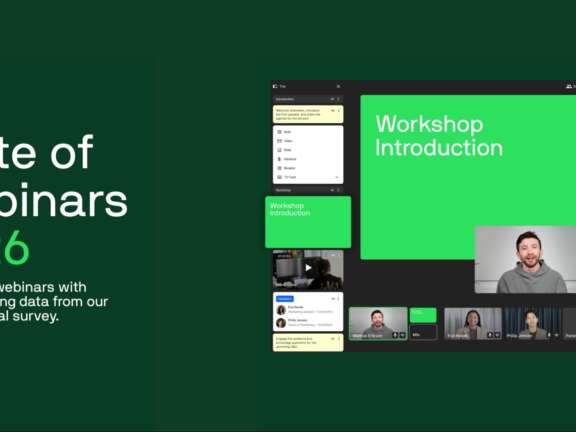
State of webinars 2024: Benchmarks & Dashboards
A deep dive into the essential video trends, analytics, and numbers you need to benchmark your Webinar efforts.
Learn from:
Steffen Fagerström Christensen - CTO & Co-Founder, TwentyThree
Clara Valls - Video Marketing Specialist, TwentyThree
Lasse Jacobsen - Communications Manager, GS1
Oscar Hjelmstedt - Copywriter and Content Producer, Telavox
Category
WebinarDays 2023View transcript
Hello everyone and welcome back to the second days of Webinar Days TwentyThree. I'm so excited that all you guys are rejoining me today. This is the annual event that we run every year for everyone doing webinars. And if this is your first day joining us and you weren't with us yesterday, my name is Amelia Holmson. I work here at TwentyThree as a part of the marketing team. But for the rest of the day, I will be your host. And I am so excited that together we're going to grow and learn and hopefully help take our webinar game to the next level. I'm very proud to announce that Webinar Days is being brought to you by TwentyThree. Our video tools are used by marketers at both growth companies as well as some of the largest enterprise companies in the world to do video and webinars. And we're bringing to you an altogether platform that you need to get real with video that is an integrated platform ready to scale hundreds of marketers as well as hundreds of marketing teams in your organization. With Webinar Days, we strive to push the field forward. We want to move the market of webinars and digital events. And part of our mission is to inspire everyone here who is participating today that is part of organizing or doing webinars. And hopefully we can learn some really amazing tips and tricks together. For this year's program, we want to encourage you to think webinars all over your business. So we have a lineup that includes some amazing speakers like our incredible content marketing legend, Anne Handley, who spoke for us yesterday in our closing session. So if you missed out on that, you can catch it on demand after today. And we today will be hearing from some of the best webinar creators in all of Europe. And I want to take this opportunity to thank all of our amazing speakers who yesterday and today is going to be helping thousands of webinar marketers as well as producers, business leaders all over the world up their webinar game. So we will be exploring how webinars are kind of breaking out of the marketing department and helping companies connect with their audiences through the entire funnel, whether it is a type of brand building event or customer briefings or thought leadership webinars. Webinars have become the most human way for companies to engage with their customers in a world that's becoming more and more remote. So for the agenda for today, we have in a couple of minutes, we'll be running a session on the state of webinars. We will have a session on how to get more participants to your webinars. We'll be talking about trailers, campaigns, personalized touch points, teasers, and so much more that you can use. And we're going to have some amazing performance agencies share their secrets on how they are building this traffic. For the third session of the day, we will be introducing webinars 5.0, the greatest innovation in webinars ever. I'm so excited for this session. And I think you guys are going to be so excited when you hear some of the amazing things that is going to be launched in the most advanced webinar product yet. And to wrap it all up, we are going to be ending the day with a cocktail hour where you have the chance to meet webinar people from around the world. This is going to be a super exciting session. And personally, I'm very much looking forward to it. We also have a teeny surprise for that session. So remember to tune in. When it comes to the platform that you guys can see me in right now, I do want to make like a small introduction because on the sidebar here, you can see that we have chats. And I encourage you guys all to chat with each other, ask each other questions, introduce yourself in the chat so you can see and learn who you're here with today. If you have any questions for the speakers, please use our question tab just above the chat. When you use this feature, we can bring the questions onto the screen and you have a golden opportunity to get your question answered by the speaker. If you want to engage, but you don't have a specific question you want to ask, please use the reactions button. It is right next to the chat. You can see a pair of clapping hands. And just to get started, take your favorite emoji and put it in the chat just so you guys get warmed up in using the software here. That's great to see. I hope that even though we're not in the physical same room, that we will still be able to create a sense of community and togetherness and come together and really learn and share the knowledge that's being distributed here today. So I think without further ado, let's just get right into it. The next session to kick off the day today is going to be a deep dive into the essential video trends, analytics, numbers you need to benchmark your webinar efforts. Our in-house team has built the next year's report based on data from 2023 and the annual state of webinars report. And this report is fresh from the press. We have been pulling the latest numbers as recent as this morning to bring you the most updated data possible. And to present this report, we have our very own Stefan Fagerstram Christensen. He is CTO and co-founder of 23. And Stefan heads up our engineering team here at 23. And every year, he's a primary pillar in contributing with the data and the numbers to our state of webinars report, our state of video report, and our state of video marketing. report. Stefan, are you here with us today? Sure, I am. Thank you, Amelia. Great to have you here. I can see that you've put on your 23 green hoodie and you're standing with a 23 dark green background. So you're perfectly on brand for this session. Yeah, I really thought about this one. Like, it's more about figuring out the hoodie that measures with the background so you don't have to go red for the background as you are, right? Then we would be in the same room. I love it. Okay, but we're ready to hear all about the numbers. So please take it away. Perfect. Thank you so much, Amelia. And thanks for having me and thanks for tuning in. So every year we do these reports that are trying to capture not necessarily kind of how one customer is using webinars, because as you know, everyone is doing different things. And that's still the dominant force in webinars that everyone is still trying out doing different things. And there's still this field where everyone is experimenting. But we try to capture across hundreds of teams doing webinars by different data sources, like who are the people that are doing different things that we can learn from? And also doing surveys, data of the market to figure out kind of where the market is moving. Is our budgets going up? Are they going down? Are people moving towards different new formats and all that kind of stuff? So we've been doing these particular reports for the last five years. This is the last one of the presses. And as Amelia said, the new one here is very fresh. It's only digital for now, but this is our starting point for announcing that. And it will be coming out both in print, but also online. So all the people that are participating here will obviously get a nice digital version of this. For the next 20 minutes or so, I'll quickly run you through the main findings of the report, talking about how webinars should be performing, giving you tips and tricks on how you can beat the market. What should you be expecting from your own webinars? What are KPIs that you should be shooting towards? But also probably what are KPIs that you shouldn't be shooting towards? So try to make that a very kind of practical way of looking at all the different data points that can be relevant, but also kind of narrow it down so you can build a portfolio of the KPIs that matter most. To help me out, I'll welcome Oskar Hjelmstad from Televox in a second. So, Oskar, are you with me? Yes, I sure am. Thank you for having me, Sniffen. Perfect. So when I'm done running through the highlight numbers of the State of Webinars report, Oskar will talk about how he's been using numbers to beef up the content game at Televox using webinars. So we try to kind of mirror them. And at the tail end of the session, we'll also take some questions. So if some of the numbers don't make sense, if you want to deep dive more, or if you want to ask Oskar about exactly how he got started on doing webinar episodes and how he dug down into different language webinars, for example, this is something that there's certainly ample opportunity to do at the tail end of this session. Thanks, Oskar. I'll kick you out of the session for a second here, and then I'll start going to the meat of the bone. So as I said, we're launching the State of Webinars report for 2024. This is our fifth year running doing this, and there's a lot of data to find here on how webinars are gaining more kind of dominant forces in terms of how marketing budgets are being spent, but also how it's not only the marketing budget that's driving webinars. And I'll run you through some of the key findings. First of all, talking about kind of how webinars exactly are gaining traction within organizations. So running the stats here, we can see that there's a slowly moving force that has more organizations doing more webinars. When we survey all of our data, we can see that, well, there's still this dominant force to say that in a year, a fourth of marketers will run a few webinars. This might be people that are just gaining, I want to say traction, just starting out experimenting. But we can see the trend here that people are moving from left to right, that organizations are doing more and more webinars year over year. There's a normalization here on the backside of COVID, where we had one year where we were seeing kind of like there's a solidification where the numbers were kind of new people that were testing out waters, people finding new formats on the backside of COVID. But this year in particular, we can see more and more organizations that are moving towards not doing five webinars in a year, but rather doing 20. So this is something that is really about seeing how the webinar market is maturing. And exactly that, nearly half of the organizations that we surveyed this year actually increased the frequency of the webinars that they run. So this messes really well with both the quantitative data that we're getting from our platform, kind of all the customers that are running webinars, setting up webinars every year, and the survey data that we did in the market. So we can see on both sides that there's a solidification where more people are gaining more ways of using webinars compared to previous years. Most organizations, though, are still kind of dipping their feet. So two or three years ago, obviously, a global pandemic had everyone really, really jumping into the field. So we're in some ways in two different markets. There's one version of the webinar market that's very old. People have been doing webinars for not necessarily decades, but certainly it's been a mature marketing strategy for a long, long time. So you'll see a pretty good chunk of respondents and also of the data set of people that are running webinars on the 23 platform every day. That kind of less than half, but still a pretty sizable chunk have been kind of maturing the webinar usage over multiple years. And then there's a new contingent that came in during COVID that is driving a new wave. So people that are starting in 2022 or even in 2023, he is still here. There's a lot of new people that are coming to an already maturing field. So that's something that we really should be looking at when we start looking at kind of what are the trends that we should be learning from. There's a lot of things to learn from the people that have been succeeding in webinars as lead gen in their marketing, as internal communications for a decade. And then there's also a lot of maturing in the market that comes from everyone being at least not necessarily removed for all the time, but everyone gaining more traction on being on camera, doing different kinds of production. So those two things, I think, marry a lot in the data as well. So that's how organizations are adopting webinars. And we can see a steady move to gaining more and more traction in kind of the organization level. But how does that marry with actual webinar strategies? Well, when we surveyed the respondents this year, we can see that the two major reasons for doing webinars is still about kind of communicating to existing customers or generating leads. That marries really well with the core realization that webinars are very much driven by marketing teams. And even the third one on this here is about kind of community building. So looking this year over year, we can see that the trend is very, very strong in the sense that, well, we are gaining more and more traction on the lead gen and particularly on educating customers. Actually, this one switched around from last year, where lead gen was the dominant source last year. But there's a widening in terms of what the webinar thing can do within the marketing team, where we see education of customers gaining more traction. And interestingly, it also means that there are different teams that end up running webinars. For lead gen, very much like a marketing team. For lead gen, it's very much a KPI that becomes about, did I get people's email addresses? Can I contact them later on? For educating of customers, for sharing information with our community, it's a wider span. So it might be the CSM team. It might be the partner team even that are starting to do more and more webinars. And that's also when we start looking at branding webinars, even internal training webinars. The interesting thing is here that the chart here year over year is widening, where there was a bigger gap between the most common reason for use webinars and the least used reason for webinars in previous years. We can see even the webinars that are not necessarily dominant ones are gaining traction. So having 20% of respondents actually run internal training webinars is something new. And that's also really demonstrating how webinars and the production of webinars, I would say, this kind of idea that you can stand in front of a camera or even run something from a webinar, means that there are more use cases for using this idea of, hey, just go online and click the like button. But yeah, the dominant force is still that the marketing team, to an extent, account management and to a lesser extent, the kind of communication teams, these are the ones that primarily are anchors for webinar strategy in the companies that we surveyed. But again, here, there's a longer tail. And that's the interesting thing that we're still so early on in the webinar journey that these numbers change year over year. And also, there are more and more use cases that are being brought into bear. So really interesting findings here that also kind of challenge us as webinar marketers to go not necessarily abandon the idea of doing webinars in marketing or in account management, but to find the different use cases where having a partner webinar might make sense, or having webinars be used in internal comms is something that becomes relevant. We ask people and we ask our data set which webinar formats are the dominant ones. And again, here, the same trend persists that the previously kind of major dominant forces are still the dominant forces, but there's a wider mixture of the kinds of webinars that are being run. So most webinars, I should say, that people are planning are standalone webinars. Out of all respondents, 60% plus of respondents said that they're running standalone webinars. Those are the webinars that only run once. They're not repeatable. They're kind of all the planning for an hour or two. All of the marketing promotion going into that. And that's still something that is really a crucial part of it. We'll come back to the idea of episodic webinars as we go on here. But episodic webinars are gaining a lot more traction. This idea that you can have programs that end up being kind of driving the idea of repeated audiences, repeated content, repeated audiences, I should say. So there is a kind of widening structure around having more programmability around webinars. Again, a sign of the market maturing. If you've ever seen me talk about these numbers before, you've looked at me or you've had me raging against the calendar. And this is something I like to do every year because, well, if you run a webinar platform and you know kind of what are the resources that go into CPU power and into streaming resources, it's kind of interesting. We can see it on our website that people are running webinars predominantly in the midweek. So a calendar for all the webinars that are running on a webinar platform like ours, we can see that Tuesday, Wednesday, and massively Thursday, those are the days where people run their webinars. And that's kind of the same thing if we just look at the core data and not the CPUs that we're using to run the ops of 23. 9% of webinars are scheduled on Mondays, 10% of webinars on Friday, and the rest, I mean, there are fewer on weekends. We kind of discard that because it's a rounding error when it comes to professional corporate marketing webinars for obvious reasons. Well, Tuesdays, Wednesdays, and Thursdays, that's where 80% of all webinars run. And there's probably good reasons for it, right? That's something about the world. That's when we have time in our calendars. But when we look at what would be the reasons for doing it, well, it's because people are more likely to attend midweek when we rationalize and say, people are probably not going to come to my webinar on a Monday, or they might be busy on a Friday or out and about. But actually, the data doesn't hold up to that. So if we look at the data for this, the attendance rate is actually, well, the same or even higher. And this is significant data in the sense that we surveyed thousands and thousands of webinars here. And so the people are more likely to attend your webinar on a Friday and as likely to join your webinar on a Monday as they are on the midweek days. So the kind of bias towards having a webinar in the middle of the week. Well, if you're optimizing to attendance, well, that doesn't hold. If you're optimizing to have people actually attend your webinar, you want to be having it on a Friday. He said holding a webinar on a Thursday, obviously. Well, attendees have higher engagement on midweeks, but that's actually not necessarily the most significant data. So you can see that people are more likely to drop off slightly before on a Monday, more likely to drop off slightly before on a Friday. And I apologize for putting in the wrong headline on this one. I should make sure we update that before we press print on the reports. But interestingly, you want to figure out what are the KPIs that are driving your webinars and are you optimizing for getting more people to convert? Actually sign up for your webinars, then you shouldn't be going for middays. If you want to have people turn up for the webinars, not for middays or midweek. And then finally, maybe if you want to have people actually have a higher engagement. Did something go wrong here? Fun. Somebody started messing around with the computer here. I'll quickly make sure that all the screen sharing, all that kind of stuff is working. We're still OK, right, Niklas? Perfect. Cool. We're doing it again. Core idea is if you want to be optimizing towards getting more leads or getting more people to attend your webinars, you want to be able to have more people turn up for the webinars. So you want to be able to have more people turn up for the webinars. If you want to be optimizing towards getting more leads or getting more people to attend your webinars, you want to be widening out the days that you're having webinars on. If you want to have people stick around for a longer time in webinars, there might be a reason for actually doing it, not necessarily on a Thursday, but certainly on a Tuesday. Same thing when we start looking at the time of day where you want to be having your webinars. People are more likely to attend your webinars in the morning. Kind of interesting. And people are also more likely to engage with your webinars in the morning. So there's a strong bias to actually having your webinars in the morning, kind of 7 to 10 hours, but also midday is where you want to be kind of keeping away from. So a noon webinar, don't do that. Again, he said in a first day webinar around noon, but the start and the end of the day is where you want to be having your webinars. So turning on to webinar performance. Now we spoke about kind of like the formats. When should I be planning out my webinars? But what should I be looking for in my webinar? What are the KPIs that I should be optimizing towards? One of my pet peeves is that there are a lot of different ways of measuring a webinar. And that's a crucial idea of kind of how we look at the world of marketing. Are we trying to optimize for getting as many leads generated, or are we optimizing towards having people listen to us talk for a long time? Both are viable KPIs, but probably their strategies are very different depending on what you want to be going for. So a few kind of standard KPIs and how they actually span out when we look again at tens of thousands of webinars. On average webinar, 284 people will sign up and the attendance rate is just under 60%. So attendance rate here is how many people of the people that actually sign up will turn out to a webinar. Average webinars have three and a half speakers. So that might be something like this thing where we have a lot of speakers in a lot of days, all those kind of things. There on the other side of that obviously one person running a single webinar. The normal here is very much having two, three or four speakers in a webinar. We split these numbers into what actually happens when you look at how many leads am I getting from live data, kind of the live webinar, how many leads am I getting from on-demand. These numbers are interesting just because they show very, very strongly how people are not necessarily optimizing the leads that they get from on-demand. On-demand is free content, right? Already ran the webinar, already did all the planning, all the creative for it. It just exists. But actually 310 leads on average from the live part of a webinar and then only 36 leads coming from the on-demand side with kind of this split. There are versions of this where we should be seeing that reversed if people are really good about them, like promoting their on-demand. But there's still something magical about doing stuff live. That is the magic of webinars. Somebody will stand in front of a camera. Somebody will figure out, wow, I didn't connect my camera correctly. I didn't connect my network correctly, apparently, as it happened here, but also the fact that it's actually real people telling real stories. So this is not an argument to be pushing everything on-demand, but it's probably about finding the balancing in between those. Just some interesting KPIs that you can kind of be shooting towards. When people actually measure their webinars and we ask them about that in survey data, the standard metrics are still the ones that apply. How many people actually attended my webinar? How many people actually signed up? There are other versions of kind of looking at this, and this is where not necessarily saying we want to be measuring chat activity or number of questions asked, but we probably want to figure out a good mixture where a good webinar for us is having a lot of people sign up, a lot of people engaged for a long time, and a lot of questions asked in the webinar, just to pick an example. So this is a pretty good kind of lineup of the things that people are measuring, but also that you can probably use to select what are the things that you should be measuring. Should you be optimizing heavily towards audience satisfaction in surveys afterwards, that's a very, very different thing than optimizing towards amount of signups. And a qualified way of knowing exactly the KPI that you're shooting for will also make you much more capable of optimizing for that in all the planning that you do leading into the webinar. And then obviously we surveyed how many people are actually taking all the data that comes from all the stuff that I just spoke about there. Actual leads coming in, whether people attended, how long they engaged, what are the chat parts of the engagement, how many questions did I get, did people download a handout, all those things, and whether it's integrated into the rest of the marketing stack. We're finding that it's a crucial differentiator in terms of whether you succeed or fail in terms of whether you're succeeding with webinars, not on the first webinar, but probably on the 10th webinar or the 30th, whether you have the data integrated into the rest of what you do. So you have not necessarily leads that are living in the webinar island and then leads that live in Marketo or HubSpot or Salesforce or whatever. So we're seeing here again a trend that more and more of the respondents have a strategy for how to integrate data from the two different parts of the marketing side. But certainly there's still a lot of room to go on here. And finally, looking at the kinds of webinars that people are actually running on the performance side, we can see that there's actually a pretty strong bias to kind of have a webinar for an hour, keep it within the hour, but there's also a growing trend to actually have people have longer webinars. So 5% of the webinars, again, out of all these tens of thousands of webinars that we looked at in the past year, were over two hours. And we're actually seeing kind of the interesting part of this is that the attendance rate, the sign-up rate and the engagement rate is actually not dropping significantly when you start having longer webinars. It's more about making sure that you have good content for it. So interesting again here is that there's a pretty solid finding around, well, we'll run for an hour, but when you start thinking about the different formats that you can be doing in your business, probably that's a call to actually be changing some behavior or having different kinds of webinars, not just with different content, but also running at different lengths. For example, ask yourself what would actually a webinar be that runs for a few hours in your business. Finally, before I cap off, we'll go to Oskar and ask some, or make sure we answer some questions, is quickly looking at the webinar budgets. So we're in this interesting time in terms of the world where we are coming back from an epidemic where a lot of budgets were being thrown into just being online, just actually being able to communicate online. We certainly saw that in the survey responses from the year just after COVID, that there was a normalization that a lot of the budget that was being spent just kind of keeping the engines running was being normalized into kind of bringing the business back. But certainly in 2023, we can see that other budgets are the same or they'll be spending more. So there's a kind of a strong sense that there's a maturation in the spending of budgets, even if marketing budgets are falling and dropping overall in our market. Webinars are actually holding their own and holding their own pretty well. Interestingly, we also surveyed people around kind of what's holding you back from doing webinars. What are the things that is actually kind of keeping a webinar program, not necessarily from starting, but from continuing? So certainly time and hosting is a part of it, but this fell over time. So the fact that that stuff takes time among the respondents actually fell from last year and even from the year before. And even the idea of being worried about going on camera or hosting in an engagement way is falling. So I take this more as kind of a maturing in the market that we're getting better at training ourselves, at repeating existing content, at finding the formats that work for us, and at measuring success in the way that there's fewer concerns and fewer massive concerns in terms of actually getting webinars to run from us. And finally, I already spoke about kind of where are the webinars running and the marketing costs and the budgets really reflect that, right? That the marketing and promotion is where the budgets are being spent for webinars. Yes, that's me running through a lot of the findings from this year's State of Webinars report. It's coming to an inbox near you, obviously. There are more findings in those numbers as well. But I wanted to highlight a lot of the kind of reasons for like when should I be holding my webinars? What days? What time of day? What format should I be doing? How should I be measuring? Should I be looking at an attendance rate of 70% and thinking that's low or should I be saying that's really high? Again, having some benchmarks for you guys to look at your data next to in terms of like knowing the entire market. I will quickly switch here before we go to Oscar. I know that that was a question from the audience. So the question here is, do you know what time of day it is? Going back to this idea of the time of day, the day of week. If it takes the day with the highest rate, there's actually not a massive difference between the time of day numbers by day of week. That's why we didn't bring them together in the report. You can actually take them and mix them really well. So the findings around what time of day you should be having a webinar will apply equally to a Thursday and to a Friday. So that's pretty much that. We will open up for more questions. But before that, I already see that Oscar is looming next to me. I'll quickly just introduce Oscar here. Let's see. So Oscar is a content producer from a Swedish company, but also a European telco telebox. I'll actually probably end up having Oscar introduce himself, but I'm really excited to welcome you, Oscar. Oscar will be talking about how they've been using numbers and KPIs to kickstart the idea of running a webinar program at Telebox. So welcome, Oscar. Thank you. Thank you, Stefan. It's great to be here. And just hearing on the insights from the report, I'm seeing things that we're doing right, but also that we could be doing better. So, yeah, but great to be here. Hi, my name is Oscar, a co-writer and content producer at Telebox, and I've been at the company for four years. But so what I wanted to show you is a bit how do we work webinars, and that is mainly with customer enablement. So let's have a look at my slides, shall we? So customer enablement with webinars. But first, if you backtrack a little, Stefan, as you said about Telebox, we're a B2B software company, and we like to say that we straddle the line between telco and tech. We were founded 20 years ago, and our headquarters is in Malmö in Sweden, just across the Oresen Bridge from Copenhagen. And right now we're actually around 500 employees globally. So what I want to highlight here is a webinar success story. And that is actually around something that we call Spring School and Autumn School. And what is this? Well, it's a webinar series for our customers and partners from our experts, our own in-house Telebox experts. And this is an initiative by the customer communication team. So as you mentioned, of course, I'm from marketing, but this project was initiated from a cross-department team consisting of marketing and sales, actually. So that's an unusual collaboration for us. So with the Spring School and Autumn School, these two seasons, we started off with Spring School, and that was 12 sessions. And we held it in Swedish and Danish. Thanks to 23, we can also adapt the webinars to be in the specific languages. You could have the questions tab can be in the respective language, things like that. So it feels very much localized. And in this Spring School sessions, we highlight the basic features of our platform. So let's say, how do I change opening hours in my PBX? How do I manage users' licenses like Telebox 101? But then moving on to Autumn School, we have five sessions, and these were a bit more in-depth, and they were in Swedish. But OK, why did we do this? So just going back to what you talked about in the report, Stefan, we do this to educate our customers. There were some instances where we invited some leads, and that was actually a great way to get them to see, you know, this is how the platform looks like, because many of the sessions were, most of them were, let's say, demos. But retention and enablement are big factors, because when we enable our own customers, and they can do more things themselves, they get more value out of the platform. And our support team, they won't have to answer the same questions again and again, because people know how to use our platform. Another aspect is to put a face to a name. So we had our in-house experts, and these were also the ones that were answering support queries or taking the calls. And there, if you're a customer, you see, hey, that's Sean or that's Elinor, you know. And of course, the live aspect is important for webinars. Of course, we could, let's say we could have recorded these and just put them out there, but we wanted to answer questions on the air from our customers and get that, you know, get that personal connection. Also, upselling is also a part of it, because some of these features, well, they are add-ons. But yes, let's look at the numbers. So when we set out to do this, spring school, our modest goal was to have 100 registrants per webinar. However, we averaged 500 registrants per webinar. And, you know, our cap for our 23 account was 500 attendees. So I was like, oh, do I have to, you know, you have to update our subscription? But yeah, when I saw these these great numbers, I was very excited. But if you're not already using 23, you know, there's a very robust analytic system in the platform. So I can see, OK, how many registrants did we have? How many attended? So as you can see for spring school, about 500 or even more. Looking at autumn school, there are fewer number of registrants that was to be expected because these were more in-depth talking about integrations and statistics. So if we look at the ratio between registrants and attendees and say this was about what would be close to 50 percent of the ratio of attendees. And I think we're pretty happy with this because we're actually very happy with this. But if you would see that, OK, well, some of them, you know, we had over over five hundred and sixty registrants, the attendees could be lower. It all the you know, it varies from webinar to webinar. But I think an attendance rate of, you know, around 50 percent, I'd say that's a win for us. So afterwards, we sent out a survey to the attendees and they thought this was informative, educational. They like the presenters. We provided people with more. We funneled them to our support page and they liked that we had some both high and low, high and low focus. And also they get the recordings afterwards. And that is not something you shouldn't underestimate the the importance of the recordings. So what did we learn about doing this and what can you take away? Well, I'd say one thing is that you don't need a fancy setup. I think we've all, you know, can be pretty accustomed to, you know, oh, should be a Hollywood production. But in this case, we wanted it to be down to earth. You know, here's here's a camera and here's the art experts. Doesn't have to be harder than that. And I think like you're just starting out making webinars in-house. You can you shouldn't set the bar low, but I feel like you don't need to have too big of a hurdle to jump over if you catch my drift. Also, preparation is key. People expect a certain amount of professionality from a webinar. So making sure that the hosts are prepared. That's great. Also, be mindful of the time we saw as you showed us, Stefan. You know, what what are the best the best times and how long should the webinar be? We hosted these these ones on a Friday. Great day to do it. Fridays at 10 in the morning. And we average about 35, 45 minutes. And then was also including questions. And what's more, make sure to reuse the content. We host these on 23, but then we move them on to our own website. So they are a bit more easily accessible through our own, let's say, infrastructure. But yeah, that was my little run through of spring school and autumn school. That's perfect. Thank you, Oskar. And I think this is the perfect example of kind of what I was trying to say before. Maybe I even said it. The idea that there is a lot of things to be picking from when you're looking at data, right? Like how many is this about reactivating existing customers? Is this about the partners is about sales? And this run through is the exact idea of like setting a goal, figuring out these are the two free things that are important to us. And then going and repeating a strategy that obviously is founded in numbers, but also finding this idea. Hey, we want to be telling a story. We want to be optimizing as we go along. In a second, we'll take a few questions from from the audience. So if you want to ask Oskar something, please shoot it into the chat. I had a few things that I was I was really interested in as you kind of went into this because you're talking about this idea of having a series of webinars or even a season of webinars. So what made you kind of dive into that idea, right? To to actually be doing not one webinar, but many. And how did they relate to each other? I feel like this initiative was because, well, we have all these features that want to highlight and it doesn't make sense to have just a one off because we want to invite people to the whole season. And also through our HubSpot integration with 23 was a perfect way to get people to sign up to the whole season and not just webinar one, two, three. So, yeah, just having it all in one in one season was great. How did you go about, I want to say, like planning the content to be kind of a season? Did you have kind of a narrative arc of whatever escalating like kind of how did you go from kind of like did you do cliffhangers like Netflix style that have you kind of been shown to the next one? How did you how do you approach it? Yeah. In some instances, we was like two parts. So let's say that we did an advanced integration and in that in that way. Okay, well, first we're going to dig into this and then into that. So instead of having a two hour webinar, we could just have them be a bit more bite sized and they could link into each other. And that way you get people that would be getting these would return for part two. Perfect. I mean, let's take a few questions. First of all, that's a question from from last specifically for Oscar asking whether whether you're using both a host and a producer presenter or how you kind of stage it with them, what kind of production and speakers, I guess. Yeah, so in this case, the the host were the presenters because we wanted it to be the people behind it. You know, the people, let's say in the hoodies doing the programming, they should be the ones presenting. So it was a bit of yeah, you know, we had to get them on board into the platform. I think 23 is very intuitive, but it's more like, yeah, here's how to do it. Here's how to present. Here's how to share your screen intuitive. But still, you need to get them on boarded and then you can get the ball rolling. Did you find that there are more people internally that are capable of kind of running a webinar? Did you get kind of a I want to run one as well? Yeah, I feel like we got the very good feedback from people wanting to wanting to partake in it. I feel like the hurdle was more how to present and how to do it in the best way possible to, you know, how to to translate through this screen. That's I mean, that's a question for for all of us and something that we all kind of like. It's the difference between being whatever people that work with customers, people that work in sales and then being kind of storytellers on camera. And we're all moving the ball forward a bit on that one. And maybe even we should then we should pick up the question from from Micah on on speakers, colleagues working from home. So Micah is asking our speakers and colleagues mainly work from home. Do you have any tips for how to set up a webinar surrounding so they feel more and more comfortable? Yeah, a great question. So for the I feel like nine out of 10 of the webinars we held, they were, you know, at at their office. We had a bit of a let's say call it a recording room. That's mainly where our salespeople do their personal videos. But in one instance, we had one person doing it from this room and the other host from his own is his living room. So that's a bit of a I wouldn't call it a challenge, but you want it to be going to have a certain baseline. I mean, I'm at home right now. So just trying to like, can you get them a microphone? Can you like, is there, you know, you need to give everyone with equipment just a set of baseline so it looks professional. And I think that that idea of baseline, I think that resonates a lot. So in my professional life, I get to kind of go around and talk to a lot of people that have approached not necessarily the content of webinars or the promotion of webinars, but kind of the planning and production of webinars extremely differently. So we like there are times when we end up kind of in a kind of studio with four robotic cameras that are kind of like scoped to run very big live streams that are also being used for webinars. And then on the other side, there are the cases where where people are well running it from from the camera that's already in their computer. And I don't want to be saying that any of these things are necessarily wrong. But for the context of a home setup, like the simple things and this is stupid, right? It's about making sure that you have good audio video or sorry, audio matters a lot more than audio in general. It means that, hey, if we are able to go to hear what the person is saying, we'll stick around for longer. We'll be better kind of equipped to understand the story and lighting matters a lot. So the most common thing is not really about kind of gearing or baselining. It's about making sure that you set up whether it's a laptop camera, whether it's a phone camera or whether it's a dedicated camera, that you set it up in a way where you're not like framed against the light and those kind of things. We all grew better at that during COVID, right? We were on a lot of calls with people that did it wrong. So we learned from that and we coped and we whatever we cleaned up in our backgrounds just as you and you did here. So like a real person with a real place and a real sense of all those kind of things. But actually, it's interesting to say that the simple tips is post a note that says smile. So people smile, making sure that the lighting is correct. Make sure probably that you're if you're running from a laptop, you're plugged into power like stupid things that we can all do. That are these like simple tips that that really set a baseline. And then Oscar, you're exactly right that the people that are running this a lot, a webcam at whatever 100 euro makes a massive difference. Same thing for a microphone. So I think we're we're coming to the tail end. At least people that are pointing at me to to hand this stuff back to Amelia. So I'll finish off first of all by saying Oscar, thank you so much for for joining me and for telling the story of how to use data to build a series of webinars and to to keep the. To to kind of keep this idea of office office season into to not only kind of doing one of webinars. That's a finger challenge to all of us to to think in informants that that scale this way. And then I'll highlight the report as well. We'll share the digital report, obviously, but also make sure that if you have any questions, if there's anything that you want to know more about from from the data, there were a few questions somebody asked in the in the question section. Whether we knew whether people were more likely to download handouts in some special special cases. We didn't run the data. Well, we didn't think of running the data. So we'll do that now. So if your questions that we can answer with the kind of the knowledge of kind of data on the platform, please reach out. And with that in mind, thank you, Oscar and Amelia. Back to you. Thank you, Stefan. Thank you for sending it back to me, Stefan. I just want to echo what you were saying. And thank you both, Stefan and Oscar, so much for running us not only through the numbers, but putting the numbers into context for us to get a real understanding of what they mean. As Stefan mentioned, the report will also be available for the on demand version. It'll be hosted on the website and you can also find the report on twenty three dot com. Now, before we are leaving the session, we are going to say hi to Clara. She is out in the field and she is visiting Lasse Jacobsen at GS1. And they're going to tell a little bit about how and why they were on webinars. But first, let's see if Clara is with us. Yes, look at that. And you have Lasse with you. Great. Yes. I love your curtains. It looks like you're in the room next to us, but you guys are actually at GS1, right? Exactly. Yeah. Lasse cannot hear you. So I'm the only one who can hear you. But that's exactly what we were also talking about, that it looks very similar to the set up to 23 setup. But we're actually live from the webinar studio of GS1 here in Copenhagen in Denmark. And as I said, I'm very excited to have Lasse Jacobsen here with us today. We're going to learn a bit of how they work with webinars and share some insights of your experience working with webinars. So welcome, Lasse. Thank you so much for joining us. Thank you. Yeah, I think we could start by introducing yourself a bit to the audience and GS1. Yeah. Like you said, my name is Lasse Jacobsen. I'm a communication manager at GS1 Denmark. So I make a lot of different stuff in the organization, a lot of videos and articles and stuff like that. But I'm also like in charge with at least the technical part of the webinars. So that's my work at GS1. Perfect. So you mentioned you're involved with webinars. Who else in the organization is in charge of working with webinars and making sure that they are a success? You know, we are a lot of people in on making our webinars. I would not be able to do it myself because there's a lot of planning with it. GS1 is a very, very big organization and it's a global organization. We are in a lot of countries, 116 countries. There's GS1 and we have like 12,500 members of GS1, which depends on that we are able to educate them. So we tend to like use a lot of knowledge in and around the organization because we have we are a very complex organization. And you need to understand how we work before I start telling you what we do with the webinars. And the main goal of GS1 is to share information or at least make it possible for companies to share information with each other because it makes it more easy to trade with each other. So we strive to help them know how to use our standards and services because we are a standard organization. We are well known for the barcode, which is like on every product on the planet almost. So we handle them and issue it to those who want them and need them. So in our organization, like I'll go back to your question, we have a lot of knowledge spread out through the company. So of course, I make everything behind the scenes, pressing the buttons. I have my colleague, Amelia, who is handling everything with invitations and stuff like that. One of the main reasons, not the main reason, but one of the main reasons we chose to go with 23 is because you are integrated with HubSpot. And she's a master of using HubSpot. So she's handling all the invitations and sending out the mails and stuff like that. So it's in an automatic flow. And she makes some noise on LinkedIn and social media as well. But we are not the important people of the webinars. The people in front of the camera is the important people because they have the knowledge to educate our members, which is one of the main reasons why we make our webinars. So there's a lot of people involved with our webinars. Yeah, that really sounds like a team effort for sure. So can you tell us a bit of how you work with webinars? You mentioned to educate people in the company. Could you maybe explain to us a little? Yeah, basically, what's the reason behind the webinars? How you how you work with them? Yeah, like I said, we are a complex organization, at least with complex products. We work with standards and standards is something that should make it easier to share information between each company. So we we really need to educate our members to learn to understand how to use it because it's a very steep learning curve to to use standards. And, you know, we we we try to to educate them on. Yeah, actually on a weekly base, but also to, of course, make some sales behind it. So these weekly webinars we are making, we we've given away for free because then we hope people will get more involved with them and will tend to to to to attend them more that we. Yeah, actually, I forgot your question. So I'm just paddling now. Yeah, just a bit of how you work with the reasons. Yeah, but that is the main reason. It's because, you know, we we are we are a organization who needs to help members to have success with using our products. So that's the main reason. Yeah, I think it was very clear. Yeah, thanks. Thank you for sharing. Yeah, and I was curious, what are some of the strategic considerations you made when getting started with webinars? So how did you decided to get started doing them? There's a lot of reasons behind it on different kind of levels. Of course, we like I told you a couple of times now, we need to educate our people, our members to to learn how to work with standards. But of course, we we have some we have some thoughts about our member service not being overwhelmed with people calling us because we have a lot of members. So were they they have a lot of calls every day. And most of them are one on one calls. So that is not a very effective way of educate and teaching members how to use our standards. So we thought about, you know, how not why not make it more like a group session. So we tried to make like weekly webinars. So we are able to reach more members at once. So they probably won't get as much. They have they will have less hours on the phone that they have now. That's one one thing. But of course, we want newbies. We want everyone to know how great just one is how our standards and service work and stuff like that. So that's also, of course, a thing we want to do. But also, it's it's it's crucial for a modern organization to seem modern and to look modern. So, of course, we want to follow the trends right now. It's webinars. Everyone use it. And it's very effective. So that's also a reason. But also, it's we want to show ourselves. So, you know, one way is to like put people in front of the camera so they are able to look at us and see. All right. They are only humans. So humanize is it for sure. Yeah, of course. That makes it more easy to to, yeah, you know, accept who we are and how we work and stuff like that. Yeah, I think that's super interesting. What would you say are one of the biggest takeaways or learnings that you got from getting started with webinars? You you probably won't be glad of how I respond. But the biggest learning I did with it is it that it's quite complex to start having webinars in our organization and build a studio, which is. Yeah, ambitious enough for us, at least for me as well. So I have used countless hours in this studio to, you know. Yeah, at first I didn't know how to make webinars at all. So I just jumped into to to anything. I just jumped into it. I didn't know how to do it. I just do it. So I needed to learn from the start. That's a that's a that's a steep learn curve as well. So that's that's that's one takeaway I've got with it. But, you know, when you start to learn from it and then you start to just do it. You've got your studio set up the right way. Actually, now, in these three webinars, we have like four or five times a week. I have my very brave colleague, Melina, sitting here. Four times a week. And I've made the studio so that she is able to just pull one plug, not pull it, press one button and then everything will turn on in here. And then we used to have like a table here and chair and the camera. And then she will be able to she will be able to with a few programs on the computer, will be able to open 23 and have webinars. So that's I have to strive to make it as easy as possible. And that you will only learn by doing stuff and make a lot of errors. We have tried a lot of things where things went wrong. But, you know, that's how we learn. Learn it. So that is a big takeaway. But I also learned that there's a lot of interest in the organization to have webinars. So we we get orders from my colleagues to how can we make a webinar? How do we do it and stuff like that? We're still trying to find out what we do when people is ordering one. And then we just also find out that we maybe fill the gap, which wasn't there before, because people are attending our webinar. So they seemed quite happy to to to to sit and have a half to one hour with us where they learn how how this one is working and how our products and standards works. Yeah, that's very nice. I'm sure you helped us a lot of people who's maybe thinking of getting started with webinars. So I also think there's a lot of audience members. It is quite time consuming. I think Amelia is saying something. Sorry, Lasse. That's just because you can't hear me. I was just agreeing with you that I think there's a lot of audience members that have also learned to grow with doing webinars and kind of been on that learning curve with us that are doing webinars and not being used to attending or know how to interact with them. But I just want to thank you both so much for your time. We have come to the end of our session, so we have to wrap up a little bit. But I know that Lasse can't hear me, but give him a huge thanks from from us. Thank you so much for being a great support. I also thank you. Exactly. Great. For the rest of you that are following along this session and would like to join us for the next one, please just stay in the webinar room. You will be automatically redirected. However, if you want to click forward to the next session, you can do it on this side. Right above the chat, there's a button in your right hand corner. And if you have to leave us, you can also catch us on demand. However, please remember to tune in for our very special cocktail hour starting at four o'clock because there will be a special surprise only available for our live attendance. So see you very soon. Bye. Thank you.


