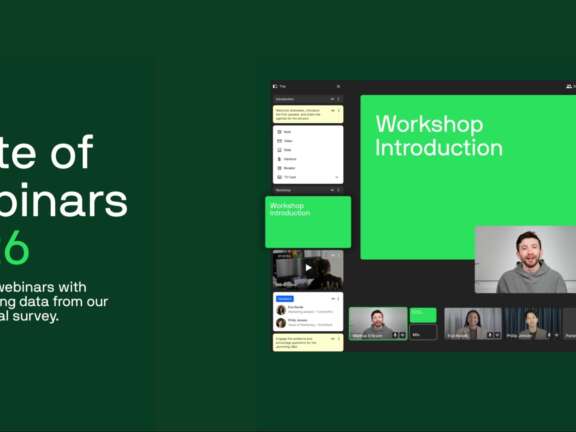
Join us for the release of the State of Webinars 2022 Report Release!
We’ve crunched the numbers and we’re ready to release our annual State of Webinars report – packed with trends and best practices from thousands of marketing teams working with thousands of webinars in 194 countries around the world. Ready to sharpen your Webinars?
We'd like to invite you to be the first to get access to the data at our Report Release Webinar on June 22nd 10am cest / 9am UK.
Just 60 sharp minutes out of your day to get the lowdown on the trends redefining how companies are working with Webinars
We’ll go deep on the trends reshaping Webinars in 2022:
🗣 Keynote from TwentyThree co-founder Steffen Christensen.
🎥 Understand the latest webinars formats and how webinar engagement is changing.
🤳 Learn how viewer behavior changes from your own website to social platforms, and the new ways webinars drives conversion.
🥇 Benchmark your own company’s efforts against industry best practice and make sure your webinar strategy is on point.
💬 Panel discussion and audience Q&A with agency experts operating at the forefront of video.
About the Report
Webinars have been exploding in popularity this year. When physical meetings are not prioritized as they used to, it’s essential to be pushing your webinar efforts forward. But before you can plan for where you’re going, it’s good to be able to see where you stand. We need a clear picture of the State of Webinars in 2022.
With the annual State of Webinars research, we share the results of the global survey with you so that you can easily see where your organisation is leading, where you’re just hitting the target and where you might want to increase your efforts.
Join the series
Thank you for signing up

You are signed up for this event.
Join the series
Thank you for signing up
You are signed up for this event.
View transcript
Good morning everyone and welcome to the state of webinars webinar. It's a bit of a tongue twister, but this is us announcing the report that we've done for 2022 in our series of market or research reports about the uses of videos, of webinars and a lot of other things in organizations. My name is Steffen, I'm the CTO and co-founder here at TwentyThree and I'm really excited about both talking about what we've learned, how our market has moved in the past year or so, but also to welcome an exciting panel of speakers to talk us through. Steffen Fagerström Christensen Happy to have you guys joining. Jesper is the senior marketing guy at Nordea Markets. So, he spends his day kind of scaling webinar programs and gleaning the insights from that. So, welcome Jesper. Do you want to introduce yourself real quick? Jesper Nielsen Yes. As Steffen mentioned, I'm working for Nordea. And part of the whole rollout of TwentyThree on a group wide level for all Nordea webinars throughout Scandinavian countries. Unlike many others, I'm more into the data side of stuff. So, I really look into the data behind all the webinars that we do, trying to figure out what webinars work the best, how do we convert people into live webinars and how do we secure to get something of value whenever they attend some of our webinars. So, that's my focus. Steffen So, perfect. Thanks, Jesper. Jesper Nielsen And we'll have you guys join the panel in a few minutes and I'll switch into slides mode. And as you can tell, I'm the main tech guy. So, it also means that I'll quickly wave and say, hi, I exist. And then switch quickly into slides as well. So, what we're talking about today is the state of webinars. And this is going to be a report that's, I want to say in a lot of ways, kind of the first new numbers post pandemic. So, this is a report that focuses on what has been going on in our market in the past year or so. So, it's very much kind of focused on data coming in from when we did this report a year ago in summer of 2021 and up until now. But these numbers are also kind of coming on the back of fundamental changes due to the global pandemic. So, in a lot of ways, the numbers will be looking at a year, but also looking at three years that massively changed the webinar markets. So, I should say that this the data that you'll see today is based both on survey data. So, we asked a lot of people how they're using webinars, what they're investing in webinars, how they scale their webinar programs internally, what the different roles are in the organization. But we also have a lot of quantitative data. So, on our platform in 2021, we saw almost one and a half million people sign up for webinars. And obviously, that comes with a lot of data. We know what your conversion rates are on landing how many people attend webinars, how they turn out, how they're doing engagement and so on. So, we'll try to marry that and actually find some of the signal that will not only tell you about the market, but also give you a sense of how you could be improving the market as we go on. All right. So, a bit about us. We run a video platform focused both on delivering video to customers, but also webinars, obviously. We host about 2 million videos on the platform. We saw 3 billion plays on the platform last year and had a high number of registrations and participations since the beginning of 2021. We had 2.5 million people register for webinars. So, if I start out, we'll run through organizations and budgets, how people actually produce in their webinars and so on. But we'll start out looking a bit at the organizations. So, across all organizations, how many people are running webinars at a high pace, at a high cadence? So, we can actually see here that a lot of customers are still starting to find their respondents in this case, I should say. How many webinars are people running per year? There certainly is this long tail where people are getting used to webinars, running, well, two, three, five webinars. But this is also numbers that have changed in the past. So, we're seeing people that are running hundreds or even thousands of webinars. It's not that often that people run thousands of webinars, but certainly there's this shift to the right, where you can see people that are not only doing one or two webinars, but actually seeing webinars as this thing that actually powers the marketing channels, the customer communication channels, and so on. So, for that, it's also, well, the new number, how many webinars are you planning to run in 2022? Is that an increase or decrease from what we saw last year? So, this is comparing numbers from 2020 with 2022. In 2020, everyone were increasing. 89% of people were increasing their number of webinars and that has fallen a bit, but the numbers are still going up and up. So, almost half of people doing webinars will be increasing their post-pandemic numbers even further in 2022. Well, the rest are going to be staying at that same pace. It also means that 90% of organizations are committing and even going deep on webinars as we go on. When we look across our customer base, people are running an average of 33 webinars on average per year. So, that's almost a webinar every week. So, that's a lot of webinars that are going on. It also calls on actually having different kinds of webinars, right? So, it's the report webinar that you do once a year. That's launch, but they're also the customer introduction webinars or the sales webinars that have maybe smaller audiences, but that are much more kind of planned and formatted to a point where they're repeatable. On the webinar adoption side, I mean, we found that, well, the market has more than doubled since 2020. That's no surprise, but actually what we've seen when we started looking at it is that, well, two-thirds of all organizations that are doing webinars started doing webinars in the last two and a half, three years. So, when did your organization start doing webinars? Well, a few started in 2022, well, more started in 2021, kind of post-pandemic to an extent. And a lot of people more, making this into like 65%-ish, two and three, started doing webinars from 2020 onwards. So, there's this massive influx of new people, new organizations that are doing webinars. And when you marry this with the fact that people are going to be doing more webinars this year than they have done before, we certainly see that, well, there's, well, interest in doing webinars. And we'll see in a bit kind of the reasons for them from doing webinars, because that has actually shifted where before it might have been, well, just as a reaction to be able to communicate to customers. What we're finding now is that people have much more solid strategies for the webinars that they're doing. Looking at how people are structuring the webinars, what are the organizational setups that people have? Well, more and more people compared to, well, two years ago, but also as company sizes grow, start having dedicated webinar teams, having setups where, well, if you're a small company, well, you might not have a specific setup, but even when you get to an organization of 11 to 50 people, a lot of people actually start having dedicated setups. Turning to the webinar strategies, because one thing is to, well, start having webinars, figure out that it works for you and start adopting it as a tool that works for communication in the company. But what are the strategies that fuel the webinars? And this is what I hinted at before. So why are people doing webinars? We asked this question of all the respondents, and there are people that are facilitating the onboarding processes with the webinars that are creating partnerships. It's like, well, one in three, one in four. Actually, what happened in the last few years is that this turned around a bit, because when we asked this question in 2020 and 2021, people were focusing much more on educating customers. And it's a pretty good measure of what people were doing during the pandemic, that people were scrambling just to be communicating, just to actually have an outlet for talking to the people that they might not be able to do otherwise. They wouldn't be able to go to fairs. They wouldn't be able to invite people to the office. They might not even be able to go out and say hi to customers. So educating customers and to an extent, kind of sharing information with the community was in a lot of cases, one of the three main things that people were doing in order to, well, were using webinars for, I should say. So what has happened is that generating leads, kind of the marketing focus, one of the core ideas of what webinars are, well, good at is this idea of actually building out leads and actually building engagement. That is a high jumper. So where generating leads before were in the top three, one in two were generating these webinars. Suddenly that has gone up massively, almost 70 percent of respondents find that lead generation is one of the main reasons for doing webinars. So that talks to the strategy, maybe also talks to still a matureization in our market is worthwhile but this is also something that we could kind of deepen and also figure out that hey well onboarding processes customer communication training there's still a ways to go on that one so what teams in your organizations are doing webinars and this is reflecting some of the same things so the top five here is obviously marketing that is the main team that is driving that is driving webinar usage driving webinar adoption that's in a lot of cases where webinars are centered for the organization and then as we look out well there's a scattering essentially like the event team the customer success team the account management team the product team and the communication teams they'll all see like well 25 to 38 that these are being used again this is a trend that's upward going where communication marketing were the leaders before probably with some of the same numbers but what we're seeing ongoingly is that there's certainly a role to not necessarily be the anchor in the organization for um for webinars in the product team but product teams actually communicating webinars account management is another thing that's on the rise this number is also going up to a point where the account management team or the sales team has started to do maybe again not widely um adopted webinars with hundreds or even thousands of participants but much more targeted but also much more ongoing webinar series and this is very much kind of reflected right that that there is this move from kind of well simple lead generation construct it's still the main driver of webinars and i think it still will be for a lot a lot of time to come but there also is a well i want to say a materialization and also some curiosity to um to using webinars both across the marketing spectrum as as and is kindly saying here but also new and interesting ways to bring it into the private teams into the communication and into the sales teams so what formats like how are people actually running and executing their their webinars um one-offs still dominate so the whole idea of having kind of that standalone webinar that is just done once is still the main type of webinars when we look across all the different kinds of uh of webinar types but people are also slowly starting to say that hey we are actually doing episodic webinars half of the respondents are doing episodic webinars defined as being something that is run on a series that is run again and again um collaboration webinars where external partners are being run in is something that's also on the rise so there's this um there's this kind of general idea of having um having stuff um kind of put in a pipeline one of the things that is going down that's kind of interesting is the repeating webinars so same content played on a loop it's not that well well surprising i would say because actually what we're finding is that we're finding is that a lot of the engagement a lot of the interaction that comes in a part of a webinar when you don't have one guy talking and producing and all those things at the same time is that well you actually get more for being live so we're seeing this kind of adjustment to repeating stock webinars not necessarily being the driving force and it's also reaction to people getting more confident with doing webinars as we um as we go along so we looked a bit at the um at the numbers on our own platform so well well people are doing different kinds of webinars but when are those webinars happening um looking at the data like the vast vast vast majority of webinars happen in the middle of the week well 10 happened on monday eight percent happened on friday and the rest happened tuesday wednesday or first day so these are the driving forces the bulk of webinars eighty percent plus happen in the days in the in the middle of the week this is something that has happened well all the time that we've been in the webinar market so for five years we've seen tuesday kind of being well the day that people gear up and then people give it give it their all on wednesdays and first days what's fun though is that the attendance for webinars is actually higher on mondays and fridays so if you run a webinar on a monday well people are going to be more likely to turn out he said in a webinar run on a wednesday obviously um and fridays are even better so this is also kind of adjustment where people are maybe kind of finding a pattern though it's like pretty easy to run a webinar on a wednesday um but data will actually be more effective and then the data will actually say that um that there's this kind of natural inclination to to probably be attending at a higher rate um the fun thing is also that people have a higher attention span or rather stick around in your webinars for longer on on first days and fridays so putting all that together friday is certainly going to be the best best way best day for you to to have a webinar we ran the the numbers for this and actually compared to a friday if you have well run any kind of advertising often means that actually from political or digital this classic um nine bucks by everyone 5% j west and so on and so forth and like what he's going to don't webinars on a friday when should i be hosting my um my webinars well people are more likely both to attend your webinars and to engage with your webinars in the morning so on the left hand side here you see the the attendance rate people have signed up are people actually going to turn out in the morning well they are more likely to turn out in the morning certainly than than any other time of the day night time kind of weird people still will turn out but but not as a higher rate and certainly they're not that they won't attend for as long because that's also the thing about mornings that people actually have a slightly higher attention span meaning that they will be in your webinars for slightly longer so schedule your webinars in the morning same logic right that you are putting the same effort into hosting the webinar promoting the webinar turning people out doing the content and everything else you'll just get both higher attendance rates higher engagement rates and generally more bang for the buck by scheduling your webinars in the morning so how are you webinars performing um or rather how are you measuring i'll get into some of the performance metrics in this in a second but we asked our respondents how do you measure the quality of a webinar so one kind of the the high jumper or the one that that certainly kind of got the most um the most respondents excited is the number of attendees how many people actually turn out um with amounts of the second one and i think these are maybe the softer um kprs in the world where number of attendees number of signups those are certainly kind of part of it whereas people that are kind of getting to a point where they are also looking at the quality qualified links generated um um is um is um is um is um success, maybe that haven't really figured out how are they how they're going to qualify the the particulars of of webinar attendance. And this is reflected in how people are, well, not only measuring the success, but also how they're taking that success and bringing it into the data pipelines. We see that, well, more than 55% of our respondents are either not tracking the data kind of not bringing it into the marketing stack, or doing so manually by either building reports in Excel, importing some CSV files into a tool. So there's also a lot of way to go on our on our materials match, recitation journey to make webinars and much more kind of streamlined tool that not only defines KPIs for for success, but also in the end, collect that data and report on it automatically. At 23, we look at KPIs this way. So like the funnel is pretty straight, get people to a landing page, have people register for your webinar. Hopefully get them to attend and then again, engage in a, know, webinar and that these kind of conversion points or the the rate, right? How many people what is your conversion rate 70% of people that hit a landing page, turn into registrants, for example, same thing for attendance rate and for engagement rate. And I'll go through some of these numbers quickly, as we look at them across our, our product. First, roughly 250 people registered for webinars on average, this is a number that's gone way up in, in the last few years, and keeps growing and obviously, like keeps being staggered that that the average webinar here actually turns out actually registers this, this many, this many people. On the performance side, we also looked at the duration, how long are people actually making webinars for? And here, there's a variety. And actually, I think that's a healthy way of looking at the world. So first of all, there are people that are running very short webinars, we are seeing webinars that might be kind of eight minutes, when bam and actually have a fairly high attendance rate, and even a kind of high cadence where they run again and again. But the most common thing is to run webinars of about an hour. So 60% of webinars range from well, 45 minutes ish, into roughly an hour. But there's also a, a drive to start doing longer form webinars, even webinars that run longer than an hour. So this is a chart that's flattening out over time. So this is something where we're seeing, again, people having more ways of doing webinars, and more ways of actually doing stuff on purpose, rather than just saying, well, we run a webinar on, well, Wednesday at noon, and we'll run an hour webinar, but figuring out content that are webinars, formats that fit the content that's being promoted, the average duration of looking at the attendance rate, and this is something where we can come back to kind of what are the KPIs that you should be looking at, for figuring out whether you're successful in your webinar strategy. First of all, the average attendance rate for webinars is at 62%. So this means that, well, 62% on average of the people that you bring out for a for webinar, will be attending that. registrations and so on. But it's a good number to keep in mind that at least you probably want to be over 60% of people that register for webinar and getting them out. People spend an average of 46 minutes watching a live webinar. So this is compared again, you will remember a second ago, I said that, well, webinars last roughly over an hour on average. And for those webinars, people will stick around for 46 minutes. So this is also really high, it actually outperforms pretty much any other kind of web content. skills. This analysis, which we also provided for webinars and of interested that there are people that are actively running webinars that don't have a dedicated webinar projects budget it is pretty logical it might be part of a sales budget or marketing budget but not necessarily something that's qualified i mean this number is going down over time but it is something that we probably will keep seeing that experimentation in the edges of webinars running a few webinars a year might not get a dedicated budget and we saw some of the numbers of whether people are going to be doing more webinars going to be doing the same amount of webinars and the budgets here match that exactly so 40 percent almost will be spending more on webinars this year and another 43 percent will will have budgets that stay at the same but very few kind of taking a step back and planning to spend less on webinars so this is another case where we've signed by refining that there's a post-pandemic kind of leveling out where we say well we'll probably keep doing the same but also with with respondents seeing that while we actually saw something here we might look at different kpis we might start doing more lead generation or whatever but we will be spending more on webinars so again this is a healthy sign for our market looking at why people are not doing more webinars like i guess the question here is what do you find to be the most challenging part of making webinars and people are very much on the time and the content side and i think this is a perfect question in a second once we we move to the panel debate to start talking to jesper and to simon about what are the what are the ways where you can like limit the time we limit the well kind of the the overhead of doing webinars in a way where everything becomes a bit more repeatable so um what do you expect you'll spend your webinar budget on so a lot of that is actually quite healthy as well right there are people that will be spending money on setting up studios that's roughly 10 people are using external services like consultants to to help out people are doing more software buying but a lot of what is happening is actually the exact same thing that we saw in managing the challenges of webinars right actually doing marketing and promotion is a really big chunk of what people are are spending their budgets on and then growing the team and creating content essentially building a team and creating content and helping out more muscle and more success kind of powering those kpis for uh for webinars the webinar tools and this is something obviously as a webinar toolmaker we're always interested in in in looking at we saw when we entered the market three four years ago that webinar tooling or webinar software is not a massively popular category of of tooling and when we ask all of our respondents across different tools that they're using getting better so so very few people would end up actually recommending their software tooling and might be because they're not using 23l well i won't show you the slide on on our customers but healthy like luckily enough it's in the right hand side of the of the promoters but this is something where again the materialization of our market is really really key all right so rounding off before we return to the conversation with them with jasper and with them with simon i'll point to some of the key performance indicators for your webinars so how can you kind of rate whether you're doing the right thing in the market whether you want to be kind of repeating these metrics might not right but at least this is a good um good four kpis to have in your mind to say this is something that i want to be optimizing for or in fact it might be something that you don't want to be optimizing for so across all of our customers successful webinar organizations they will run roughly 33 webinars per year so for a lot of you guys that will be higher than what like naturally the average will will reflect uh reflect across a lot of different organizations doing different kinds of webinars but it's something to keep in mind that there is probably room to grow the number of webinars being being done conversion rates and landing pages at 65 percent um i'm very proud to say that we outperform the market vastly on our landing pages so it is something to both be proud of but i think there's more to go here right that making sure that well the efforts the marketing effort that is already being spent getting somebody to hit a landing page for a webinar well make sure that the form is right make sure that the communication of what people can expect from webinars right make sure that you schedule the webinar in the right time that matches people people's expectations and you can certainly be outperforming the 65 conversion rates that's average across all of our customers attendance rate is at 61.70 percent um so live attendance rate is really important um for for all webinars so it's kind of crucial to figure out how do you get the people that you already signed up the leads that you already generated to actually come and be part of your webinar and to spend well i guess 46 minutes in your um in your company um here again there's a lot of variation there are webinars where people only turn out for 20 or 30 percent but kind of in general this is a good measure to go on if you have an attendance rate that's lower than 60 percent probably you should be reviewing what can i do more in order to actually get them get people out to my to my webinars and finally webinar engagement will obviously like it will vary greatly depending on the well duration of the webinar if you have a eight minute webinar probably don't shoot for 86 minutes or 46 minutes of engagement but it's another one right where you want to be making sure that you can kind of benchmark how your webinars are doing compared to the rest of uh the the the the the the the the of the market and these are ones that we're happy to kind of help you review at 23 so if you have questions about this questions about how you're comparing to this please reach out to our specialist team and and we're happy to well at least give you some pointers and some ideas on how to either be doing more webinars how to con like how to change some of the or improve i guess optimize some of the kpis that you're seeing as you're kind of progressing on your webinar journey that is it all of this is um is coming out in a report that will be in your mail inboxes later today so it's uh it's a big like primer on that one and i'll switch i think just to uh to our panel mode here and make sure that i still have simon and and jesper with me but apart from that um as i said we're really really happy to um to be part of kind of giving more knowledge about i want to say three years two and three years can you talk a bit about like where you started in terms of uh of numbers and how you've been kind of expanding on on the program in uh in that time sure i can give a little background here uh post covet we were also doing webinars and and we've business business area so only for large corporations institutions that is our main goal so this is only for b2b webinars that i'm that i'm referring to now so obviously when uh copit hit us in in in month of march we went from doing these three four five webinars to 30 35 webinars a month and that has basically continued so we saw you know a huge spike for the for the first six months when covid was really um hitting us. And then we were kind of expecting to kind of see it level out and starting going down. But when I'm looking at the numbers for last year and this year, so last year we did about 150 webinars. Today, this time of year, we have almost reached that number halfway through the year. So I actually asked our webinar managers and event managers this year in the beginning of the year saying, so what is our target? Are we going to make more webinars this year or fewer webinars this year? And they all said they expect us to do fewer because they wanted to go into normal events where we had people coming to a hotel or coming to Nordea's facilities or we're meeting them in face-to-face. Problem is our customers really like the webinar format. So they started asking, hey, if you're hosting the webinar and the event, can we just mix it and match it? So now we're facing a new reality, which is hybrid events. So that probably explains why we kind of halfway through the year are seeing similar numbers of webinars that we did all through last year, because now the format is being solid and people know what they can expect from us. So that's a little bit about how we see the world. Interesting. So what are the, like, how do you measure success? I guess at 10, like, I don't know, it's going to be one. But have you seen a change in how people evaluate webinars as you've kind of scaled them up? Yes, we actually, a couple of months ago, we actually started a program where we now have the same questions for all our webinars that we're running in the, not in five countries, but in five languages. So now we have the similar questions when we have webinars and people are opting out, we have this three or four questions that we're asking. So now we have that as a KPIs. in our measurement system, we want to have a rating above 4.5. for our webinars in that's our that's our targets. Now we can compare all the webinars that we do on the same questions and seeing our performance on par or below what we want to be. So so yes, we are moving into looking at the questions that we asked them. And we also, I also do specific reports for people who want to know what is the engagement level, and we look at how many questions and how many chats do they get. So we're looking into that. Really. close engagement rating. Is that something that you've kind of, I mean, it's vastly interesting because the engagement kind of measures like how many chat messages and so on, but I guess that's something that you're then training the host to be more aware of as they, like they will actually do the thing that I forgot to do to say, well, go ask questions and we'll answer them later and all that kind of stuff. And it actually depends on the webinar team and the webinar host. Some works with both questions and chat open. Some only works with questions open. So they kind of really want to have people ask questions in the top right hand, post a question and then we can take them. And some really like the openness and just the real engagement where they can see everything. So right now we don't have a specific format. It's kind of, it's still open for everybody to kind of choose their own kind of thing to do. Perfect. I'll bring in Simon because Simon, to me, you're the guy who doesn't just say we should be doing more video and you should be doing more webinars, but that actually help people kind of achieve that, that actually kind of like put power to that. And one of the things that we found in the survey, and I think that's something that Jesper hints at both being a challenge, but also something that is ongoingly being solved is how to kind of plan and execute webinars and I guess plan and execute And I think that's one of the things that we would normally go to Simon to ask about how you, how it's being done. But can you see that that kind of frustration being an ongoing thing in your everyday life as well? Is that also maturing? I think it's all about content for me. Hi, I'm Simon. I'm based in London. I'm a video strategist and I support businesses in content, which generally video driven and let's face it, webinars are video driven. And it needs to be part of your strategy. I think webinars are great. I think potentially people see webinars as a interesting about budgets about we can put webinars on quite cheaply compared to actually creating sort of high quality sort of recorded and edited video content. And for me, it's all about how to integrate it into your whole strategy in terms of whether it's marketing, generate leads, onboarding new clients. So. And you should be thinking about all of this in terms of content creation, creating that brand video, creating the social videos, but also looking at webinars because what's great about webinars, as you pointed out, is the engagement is actually long. So not many people will watch potentially a, an edited video for an hour, unless you're watching Netflix or a documentary, but it's interesting that people will actually engage with a webinar for 46 minutes, right? So. I can see that we're almost coming up to that now. So we've, we sort of. Some people joined late. It's fine. That's fine. That's about engagement. It's like any content you create, how do you create engagement? It's all been on webinars where people are just, you see one person talking at the camera for an hour, right? And that's going to put, I would say, switch people off. So it's about how can you make your webinars engaging? I think 23 have lots of tools you can use. I mean, one, one is greatest is obviously bringing speakers in is one way of doing it. That was presenting. Presenting slides. That one is actually bringing in video content. Not many webinars actually play a video into their webinars. There's one thing that I like about the 23 platforms. You can actually integrate any video content you create into the webinar and actually plays back really well because a lot of web platforms I've used in the past playing back video is horrible. You know? So it's about that. It's about, it's about creating polls. It's doing shout outs to, to your audience here. There's one thing I like to pick up as timings really. It's about when's the best time, right? So interesting for me, Friday. That's interesting. I'm wondering if, if people are working from home more on Friday, maybe they'll do webinars. It's interesting, but it's a number that's held out like really well over time because we were thinking like we ran these numbers internally first in like 2018. And we were thinking there's something here. It might be people that are running a different kind of webinar, but as we've increased kind of the end of how many webinars have run on the platform, it is something that holds up a bit more. It might be. It might be that, well, the hosts are better on Fridays because they're in a better mood or whatever. Honestly, it's probably part of the, part of the mix as well. We have a lot of questions, but before that, I wanted to talk a bit about, or I wanted to ask both of you about, it's not really about training, but getting people to be kind of comfortable on, on webinars. Again, it's down to one of these things that, that kind of like, what are the things that are holding back like webinars that yes, but how have you been running? I know you have, I mean, 50 some people hosting webinars in, in, in the past. Is that a right number or is it more? Let's The number is actually bigger. We have about 200 people who actually have access to actually being able to run webinars for, for Nordea. And most people are very comfortable in just running them from, from the laptop, which is our normal way of actually running webinars. But we also see a huge interest. People have, have been, been taking into webinars and they want to use our TV studios that we have in, in all our premises. That's true. It even works in banking. Yeah, and especially for those of our people who we call webinar stars that are well-known branded people that we promote in the media, they're really used to getting a camera right up in their face. So they're really good at this. Obviously, there are some of the more new newcomers that is only doing webinars once in a while and still struggle with kind of, am I looking to my own screen or am I looking in the camera or why do I look at it? But a few webinars down the road and people know how to look in the camera and talk to the audience that way. So we definitely see that it doesn't take long to get comfortable with having all that. It's about practice, really. It's about actually doing it. I know the first couple of webinars I did, I was absolutely terrified. It was like, no one's going to show up and no one engages and sometimes you feel like you might be talking to yourself. But part of the work is actually trying to, is promoting it. But once you get here, I mean, I know I've seen the comments, people talk about my camera, okay? And I think the tech is important. People talk about laptops, but I think if you're going to produce regular webinars, you don't need a full-blown studio. This is my home office, actually. I do have a 4K camera here. It's a Sony a6400 to be technical. You know, but it's important to present yourself in the best way possible, right? So I have this set up. It's not hugely expensive. It's got a couple of lights here. And, you know, and, you know, it does make a difference because I always get comments on, how do I, why does it look so good? I don't know if you saw the question. I just pulled it up as well. Like, every time I'm on a webinar with you, everyone is like, well, Simon looks so great. Why don't you look great, Stephen? That's because I'm not using a laptop. Okay. I've actually got a VES camera. I've got a proper camera here, which is plugged into my iMac that I have here. As I said, it's not that expensive to do this setup. And I think. It's probably worth anybody considering doing webinars on a regular basis should be able to create a little studio like this. You know, it's not that difficult to do. It's not that expensive to do, but it does make a difference in how you turn up and how you present yourself. I mean, I agree today, at least. That's one of those days where you can't disagree with that statement. I'll pull up a question here from Kijia about the ideal number of speakers. And I might kind of turn this question to you, Jesper, after I've pulled out a key stat that probably didn't make it into the report. But on average, webinars have 3.3 speakers. That's again across 200,000 webinars or something like that planned on the platform over the span of multiple years. But what are the ideal number of speakers? How do you kind of figure this in, Jesper? Well, it is not a measure that we actually, we don't look at that hard. But when I look at the stats, I can see that some of our recurring webinars that we have weekly updates, we have two people who's running them. Then we have bigger kind of flagship presentations where we bring in a broader variety of experts and key people. And obviously, that brings in a larger number of people. So for the large-scale webinars, we see maybe four to five people. And for the standard, we have weekly updates, one to two people. And then obviously, we have the dedicated webinars where we have one key person whose only job is to actually speak. And so I think we are all over the place. And I guess it depends on the kinds of webinars, right? They're the ones, I mean, I can pull, actually, I think it comes as a part of the same. I mean, it's one thing to say, well, people are running all different kinds of webinars. but what would you say the ideal length of a webinar is? And I think for my money, it's not about having an ideal length. And I think, I know Simon will start talking about content because that is exactly it, right? It's more about making sure that you kind of know what you want to be saying in that particular kind of webinar. And I guess, Jesper, you guys have it feels like you're running, maybe even at least weekly, very short webinars for the same audience, episodic. Is that right? Yes. We run in around 10 to 15 years. in several countries or basically in all countries, we run something we call Monday Macros, which is brief updates for the economics for this week. And they're typically run at eight or nine o'clock in the morning, and they're about 20, 25 minutes. And it's really, you know, a fast paced webinar with the same setup every time where our key researchers just give a statement of what are we looking into this week in terms of economics and what happened last week and just a short reflection of that. So people kind of know, it's like a news broadcast, basically, where everybody knows the format and everybody knows this is how we're going to do it. And then for the longer webinars, the flagship, we do a lot of pre-work and marketing that setting the expectations of, okay, this is going to be a deep dive. It's going to be longer and more thorough discussions about it. So depending on how beefy your webinar content is, the longer it gets. So that makes, I mean, it makes logical and perfect sense. Simon, the templating of stuff, is there like a go-to template that will generate successful webinars? I guess like key metrics being one, but actually I think the template here is more kind of talking to kind of the description, the presenters and the length and the presentation. Do you think it's possible, I would say, even to kind of do a one-touch template or something that becomes like the primer for making webinars more approachable? I think it really comes down to your audience. It comes down to who you want to join your webinars and what result do you want from it? I think you can template a lot of things. You can template in terms of a style. You can template sort of a format in terms of it's just going to be host-only. Are you going to have one or two speakers? I think you can template in terms of, can you have like a video you can play in? It could be an intro. It could be an overview that you can do. Again, you could probably template some slides as well. So I think the format you could template, particularly for an engagement point of view in terms of where you're going to ask a poll, in terms of timing, you should have the timing sorted out in terms of main content, time for a poll, time for a video, time for Q&A, and then a wrap-up. So I think you can, like any content, it should always be planned. You shouldn't sort of go press the live button and then see how it goes. You have to work it. Well, webinars, who knows? That's the issue about going live, right? Sometimes, you know, you do have some technical issues, which are beyond your control. That's sort of the fun of going live. That's probably not the fun, but it's the stress of it. But it is certainly fun. Actually, and it also, like, I mean, you can argue whether it added to quality today, but it certainly adds to the, to kind of the conversation and probably also to the vigor of a webinar. I totally agree. There's something about live, which is a bit more, it's up to your energy and your adrenaline. And also with live, it is more engaging, you know, because you can get the comments, you can see the comments, you can engage with people on, in a live situation, which I think it's really good. And I think in terms of structure, yeah, I think in terms of, I always, in my webinars, you always structure the timings, because for me, I think it's important to hit that hour, yeah, and not go over it, because you need to respect people's time as well and try and make them, you know, you want to make them as engaging as possible. So you cover all your points, you can get the chance to answer questions as well. Perfect. I think we're nearing the end. I have one, like, actually, I guess, very specific question to Jesper. Let's see if he's, if he's still with us. Let's see here. That's more about kind of the next step after KPIs. So this is, this is a specific question about how Nordea has integrated train-free with marketing automation and some of the challenges in doing so. And so I guess, like, data is integrated as a part of your automation and your marketing pipeline. But Jesper, can you talk a bit about how you've, how you started out and what the challenges have been along the way? Right now, we don't have a full -end automated integration. But what we have started is pulling all the data from all the webinars, all webinars throughout the day, both for the area that I focus on, which is large corporations, but everything else. And we have now built a huge set of reports, and we're reporting on that we're using to kind of figure out, okay, so what is it that we actually want to report? And what is it that the stakeholders want to know? How can we easily convey all that data and knowledge that we get from the webinar system and bring that to them so they have an easy to understand dashboard? And then once we have that in place, we'll, I'm working currently now on getting everything automated. So all the data will just run and flow directly into the web that I've created for this. So that was the intention to create the dashboard first, what is that we want to measure and then build integration afterwards. So we know exactly what we need to pull. Yeah, I think it's a really good point that, I mean, it probably also talks to this idea of what are, like, not only all the KPIs that can be gotten at, but actually building that dashboard that is focused not on having all the data in one place, but actually more about what do you want to be reporting to the people that are running the webinar. And the people that are ultimately using the outcomes of that. All right, I think with that in mind, I'll say thanks, Simon. Thanks, Jesper. Thanks, everyone for being with us. Thanks for whatever technical troubles we got along the way. I hope that at least the last 50 some minutes of the presentation got you both to be smarter on kind of what webinars are where we are in 2022, both from the quantitative side, some of the KPIs that that can be used. That can be optimized, but also from the conversation and the questions to Simon, and Jesper, knowing more about how do we approach the challenges of webinars? How do we actually embed webinars in those KPIs into scaling up our webinar program? So thanks for being with us. And thanks, Simon. And thanks, Jesper, for taking the time as well.


